Photo Credits: Adobe Stock
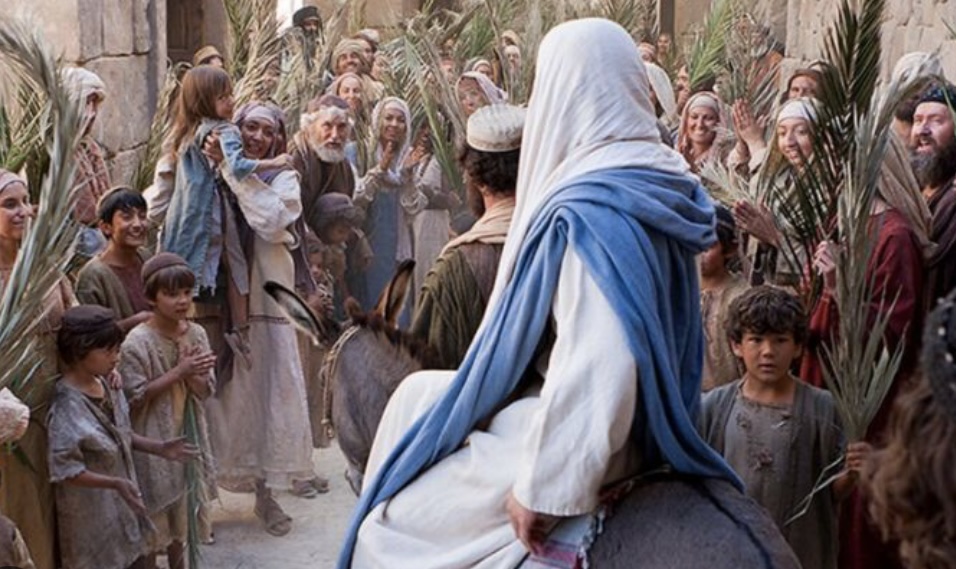
Palm Sunday begins next week’s harrowing account of our Redemption. Over centuries legends have magnified the event to set our dispositions toward a meaningful appreciation of what happened on the coming important days. For instance, we have adopted palm branches as the “leafy branches” one of the evangelists describes in his gospel, when actually palm trees do not grow in Jerusalem. Then, there is the debate among writers, that because it was a common practice to welcome pilgrims to the Temple by groups of singers and dancers, that Jesus was a simple pilgrim during the feast being welcomed this way.
The other side of the debate, however, is that Jesus fully knew that this conspicuous Passover would most likely be his last. The fact that the evangelists describe his methodical arrangement of securing a donkey and a colt, and his riding the donkey up to the gate of the temple suggests, as Gerhard Lohfink says, “He wanted to come to the city as a poor, unarmed king, the messiah of peace of Zechariah 9:9.” He would not journey into Jerusalem on a horse, the symbol of conquest. “Apparently,” says Lohfink, “Jesus read his Bible with an unfathomable sensitivity to what is essential.” (Jesus of Nazareth p. 247) So, yes, Jesus was a simple pilgrim being welcomed into Jerusalem, but he planned it to make a point, to connect the Hebrew prophecies with his call to suffer, die, and rise over the next several days. He planned it to come as a simple Jew pointing out a kingdom not of this world. I prefer this interpretation.
The story of the Entry into Jerusalem is a rather short narrative in each of the gospels. However, several writers hold what Lohfink writes that “…Jesus could not avoid the temple…the king or ruler is responsible for the temple.” Note that one of the evangelists says Jesus “inspected the temple” after he arrived, just as a king or ruler would do.
Toward the end of this most holy week, we will encounter Jesus’ teaching being shredded before him as he stands accused of falsehood after falsehood. The long march of evil that began in the Garden of Gethsemane at his arrest will make us reflect on what evil can do when it has been controlled by willing and weak co-operators.
I suggest you partake of services throughout the week for the purpose of helping you to see where you can be a better person, a better believer. Even the slightest practices like popping into a church for Holy Thursday or Good Friday services. You will feel different afterward. Or, read the passion narrative alone in your room or in the quiet of the woods outside. Make Holy Week special for your soul.
Last year a family member sent me a beautiful memory of her childhood sharing a Holy Week activity with her father who was a Lutheran minister. She recalled tramping through the woods near the James River in Virginia as he searched for the right weedy growths full of thorns. He wanted to cut the thorny branches for a crown of thorns he would make for the large cross in his church. Selecting and cutting the branches was a major difficulty. Sometimes he would have to go deep into brush and the thorns would tear at his flesh. His little girl would cry for him to stop but he would say, “Honey just think of the thorns that Jesus accepted for us.”
Once home, my friend’s father would wrestle with the thorny branches again as he laid them in the church yard and began weaving them into a large crown. Then he would climb a ladder to hoist it over the cross, so it hung facing the congregation on Good Friday. Against a golden glass sanctuary window, the crown of thorns came to mean different things to various members of the congregation as they prayed on Good Friday.
To his little girl, the minister’s painful yet loving effort to provide a meaningful symbol for his people, has become a loving memory of her father: a good man bringing to reality what love sometimes inspires us to do. Isn’t that why Jesus rode into Jerusalem?

Reflection
This week we will ponder the events that led to our faith as Christians. Nothing is too simple for us to offer in praise to a loving God.
- We can make the Triduum from Holy Thursday through Holy Saturday; we can take quiet time to pray in gratitude for our Redemption. We can ask for guidance on how to live, from the core of our being, the message Jesus brought to Jerusalem.
- We can join in spirit with our brothers and sisters who celebrate Ramadan at this time and those who have celebrated Passover a few weeks ago. Our traditions are linked, our humanity bonded. This is a way to spread peace.
It is our own entry into Jerusalem.
Shalom! Peace! May it come to the Holy Land of our faith and the holy soil of our hearts.
 In All Things Charity
Leave a comment