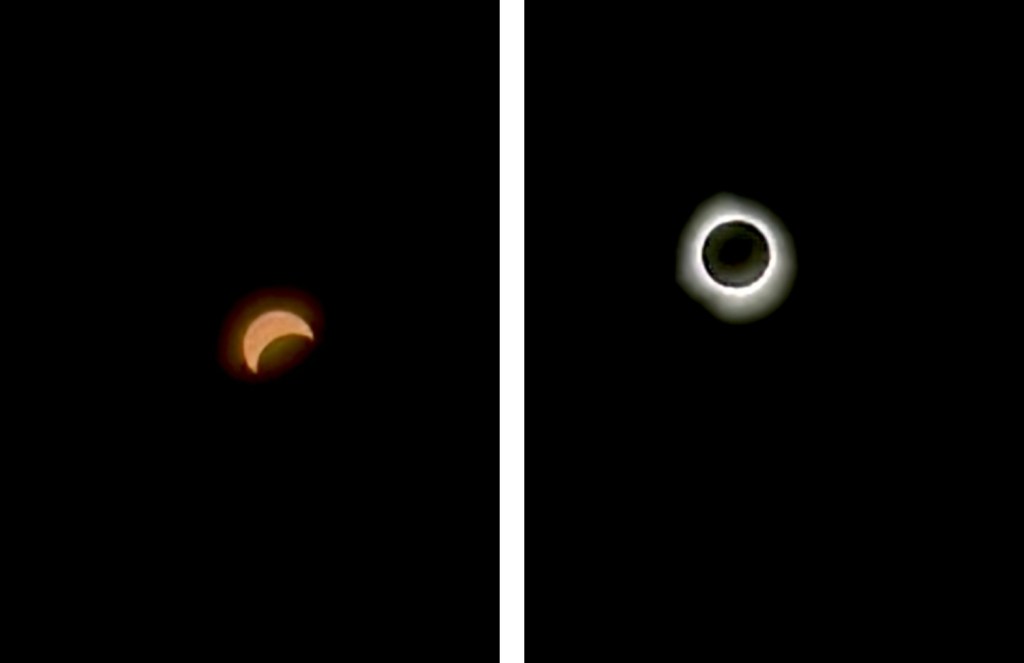
The total eclipse experienced here in northeast Ohio last Monday still has people talking. In the dentist’s waiting room today, a woman joined me after she announced herself to the receptionist, plopped herself across from me and immediately began: “How about that eclipse?” We rattled on about it until I was called to that ominous chair for treatment. We’re still seeing news reports and reading articles that can’t give up the miracle of that moment when the moon blocked her majesty, the sun, and we watched in awe.
To many, the total eclipse provided a spiritual taste of what life can be like if we abandoned divisions and looked to the harmony of the heavens for the quiet, mysterious movement of something unique. A journalist in The New York Times wrote, “It is a reminder of the collective experience of being alive, of the dance between spirituality and science, and the sheer astonishment at being part of the greater story of things.”
As one of my sisters and I sat on our folding chairs in a nearby park, we watched the parking lot fill quickly with cars from all over the country. Soon people were talking to us, telling stories of their journeys to Ohio and the excitement of their children and family members who gathered with them. One couple came from Philadelphia, another from College Park, Pennsylvania, and another from Alaska. It struck me that all of us were travelers, as in life, seeking an awe-filled moment at the end of the journey. We were astronauts of curiosity, beauty, humanity and transcendence. One scientist wrote, “In modern society (the eclipse) offers a sense of belonging, a collective moment like the religious expression of prayer and gratitude.” Around us families were enjoying picnics, children were playing ball, adults were laughing and talking; an atmosphere of joy and camaraderie wafted over us and meandered in and among us as if we were all part of a big family reunion. I fully expected God to open heaven’s gate and shout, ‘C’mon in. all of you. I’ve been waiting!’
Psychologist Dacher Keltner said, “There is something profound about sharing our aweness of meaningful events.” Vatican astronomer, Jesuit Brother Guy Consolmagno said, “The universe is elegant; it is beautiful and it’s beautiful in a way that surprises you. Maybe it’s a sense of what God is like.” When totality occurred, people cheered; some grasped their chests emitting loud, exclamatory sighs, parents hugged their children. Hands were extended, embraces locked friends and lovers—all the while with eyes fixed on the heavens. This is the nearest experience to stepping into heaven because all around was sheer, innocent love and joy wondering at something out of our control given at this moment to make us forget everything that is not awe or love.
Reflection
Solar physicist Ryan Milligan wrote in a recent article, “You don’t just see the total solar eclipse. You feel it completely.” Urging readers to travel anywhere in the U.S. to experience the eclipse, he said, “A total eclipse elicits a unique, visceral, primeval feeling that cannot be evoked by a photograph, or video, or newspaper article, and that can be experienced only within the path of totality when the moon completely obscures the disk of the sun.” Milligan suggests that beholding a total eclipse is more of an experience than a sight. I would attest to that.
Many physicists are drawn to poetry and compose wonderful poetry centering on mystery, the physics we try to understand and the poetry we find mysterious and sometimes beyond comprehension. The recent Oscar winning movie, Oppenheimer, highlights on the eponymous character’s reliance on literature several times. Like many physicists, he was an amateur poet intrigued by the poet’s and the physicist’s effort to explain the unexplainable and to use the beautiful in the effort. Oppenheimer names the bomb he created, ‘Trinity,’ in deference to John Donne’s sonnet, Batter My Heart Three Person God. Oppenheimer and nearly all the scientists who worked at Los Alamos, lived the rest of their lives torn by the irony of their creation against the existence of God’s creation. Oppenheimer may have spoken for most of them whose hearts were battered by creating something so destructive against a universe so beautiful.
As we are still warmed by the glow of the eclipse and the experiences we had, maybe we could ask ourselves:
- How do we show reverence for the mysteries of the universe—and all creation—which should bring us closer to God?
- In our prayer life, are we open to new practices that might make us aware of God’s immense love for us, an immensity immeasurable to our human mind. These practices could include yoga, reiki, meta meditation of Eastern faiths.
- Explore unfamiliar types of prayer just as an astronaut might explore different ways of living in the pursuit of truth in space. Truth is in everything God created; it is exciting to search for it. You are thus allowing those truths to enlarge your own faith and lead you further into God’s embrace.
I hope all of you, my readers and my anonymous angels, will find joy in exploring the space within as you reach for the God who waits there for you.
“I, a universe of atoms, am an atom in the universe.” Richard Feynman, Nobel Prize American Physicist
 In All Things Charity
Mary Ann, Thank you so much for describing your experience of the total eclipse. I experienced it just a few miles north of you in Mentor, OH, with a group of friends. When the darkness descended, the frogs in a nearby pond began to croak, the birds in their nests began chirping their night prayers, the traffic on the road ceased, the streetlights came on, and the temperature plummeted 10 degrees. It was incredible! We all joined together in singing “Amazing Grace”– to thank our Creator God for this magnificent Grace! Your blog today captures so beautifully the power, awe, mystery, and delight of this astronomical event! Thanks again! Melannie
LikeLike
Thank you Melannie…Your experience resembled mine in many ways. Everyone was cheering–like your singing. I got the chills feeling as if I was in the pre-entrance room for heaven! It was happening. A spell-binding beautiful event full of God’s love. Thank you for sharing. Mary Ann
LikeLike
I felt the eclipse was but a small example of what we can expect when the Christ comes again. There is nothing like a heavenly “happening” to make one aware that was written will indeed be fulfilled. As I watched the moon’s path, I could only pray. We take for granted that each day will be light and each night will be dark. But then comes God, and He shows us that we should not be complacent with what we expect life to be. And He takes that moon and drives it across the sun, every once-in-a-while, to show us who’s boss. I still see the eclipse as a wonderous act, and what happened in me because of it, I will cherish.
LikeLike
Your reflection is right on target. It was like the Second Coming!! It was undoubtedly a spiritual experience. Thank you for sharing. I like your phrase, “But then comes God…” So true. God turns it all into miracles. Thank you–Mary Ann
LikeLike
I agree with the previous comments. It occured to me that during the totality, what if that was a permanent condition and our sun was forever darkened? What a horror that would be! Thanks for the reflection, and gratitude to God for this event. It’s too bad that so many people with little or no faith don’t recognize the TRUTH behind it all is only in God!
CRATH0619
LikeLike
Chris: Your thoughts are stimulating. I even thought of composing a science fiction plot about a permanent eclipse and how we would have to change our lives. The reality of the spirituality of this experience was tremendous. Thank you for sharing. MAF
LikeLike