One of my favorite characters in the Christian Scriptures is Nicodemus, the Pharisee, rabbi, member of the Sanhedrin who stealthily observes Jesus before going to see him in the darkness of night. His story is told only in the Gospel of John. Scripture scholar Fr. Bruce Vawter explains that in this gospel, what seems dualistic or binary such as John’s metaphors of light and darkness describe the “warfare fought within the human soul.” John goes beyond Judaism, says Vawter, “the Law was given through Moses but truth through Jesus Christ.” Who would believe and teach with firmness all about the Law but a good Pharisee and rabbi? Our friend Nicodemus was just that: a respected leader in the faith, a teacher of the Law.
But something was luring him to look into this new Teacher he had heard about. A warfare began churning in the soul of Nicodemus. He knew the Law so well that he must have started wondering: Could this itinerant Messenger be the One we have been waiting for? He probably noted that the first teaching Jesus provides in the synagogue in Nazareth comes from Isaiah, “The spirit of the Lord is upon me; therefore, he has anointed me.” (Luke 4:18) This Teacher quotes so many Jewish teachings and they seem appropriate to his ministry and, yes, his very Person. I wonder, thinks Nicodemus, if he is the One.
So, Nicodemus begins to explore on his own. He walks incognito at night toward the periphery, the outer circle of Jesus’s group of followers as they begin to leave him for the night. Several evenings, at dusk, he captures the end of some teachings. He notes how the listeners, bedraggled and ragged as they are, illiterate for the most part and desperately poor, hang on to promises of riches for their souls and happiness in heaven if they learn to love the Creator and each other, to give their last tunic to someone, to render to Caesar what is his and to God what is God’s. They hear about forgiveness that challenges the Old Law’s dictum of an eye for an eye. A revolution could start when these poor are encouraged and told they are worth something. Daily, Nicodemus is witness to miracles and signs that the new Teacher is affecting. This is becoming overwhelming, too much to resist. What must he, Nicodemus, be aware of and prepared for? Vawter says that for every reader of John “the meeting of God and man must take place.” So now we see that Nicodemus must encounter this Teacher; he must hear directly from him: personally. Alone.
It happens one night under the shadows of street candles after most people have retired to their homes and after Nicodemus has signaled to him from a crowd to follow him to the alcove of an alley where they sit on large stones behind the stall of a merchant’s booth, a place where no one can listen to their conversation. Nicodemus tells Jesus he is impressed with the signs of his miracles. Where does this come from? Is it connected to the teachings about faith and love? He needs to know. The Law is at stake.
Then begins one of the most comprehensive explanations of this new teaching in all the Gospels. Is Nicodemus converted? Yes. But in a unique way. He continues as a rabbi but later in the gospel, he defends Jesus when other Sanhedrin members begin to question Jesus’s teaching. Finally, he appears at the crucifixion of Jesus and in broad daylight this time, is unafraid to assist other disciples in the removal of Jesus’s body from the cross to the tomb. After the burial, he visits the tomb with 100 pounds of myrrh to anoint the body. The Law of Moses has been replaced by the crucified Teacher. Nicodemus has found his Lord!
Reflection
Some of us see a bit of Nicodemus in our own selves throughout life. What about when we know in our conscience that we must stand up for something, something most people around us are not inclined to support? Do we rely on the teaching of our faith to guide us? This takes courage and prayer to venture into the dark night of opposition, but it is the right thing to do if it is of faith.
And what about our faith itself? Has it weakened through years of distrust and anger at what our religion failed to do for the common good? Have we wandered about the periphery of the place of worship wondering what we might be missing that would bring more happiness to us and our families? Are we angry about our faith? Curious? We might be inspired to check out the times for services like reading the menu on the restaurant door before we decide to eat there or examining the books in the window of the bookstore before entering. We just might be feeling the lure of God calling us to make community within those walls and then take it outside to the brightness of the world. Perhaps we have to go in the dark and sit in the back of the assembly. Perhaps we have to recognize that we are immeasurably loved by God and want to feel and live that love and learn how much it will change our lives for the better.
Perhaps we are just like Nicodemus. Too much pride to hold on to and too little courage to open the door. But we will meet Jesus there. Open the door and walk in. This is the beginning of a new relationship.
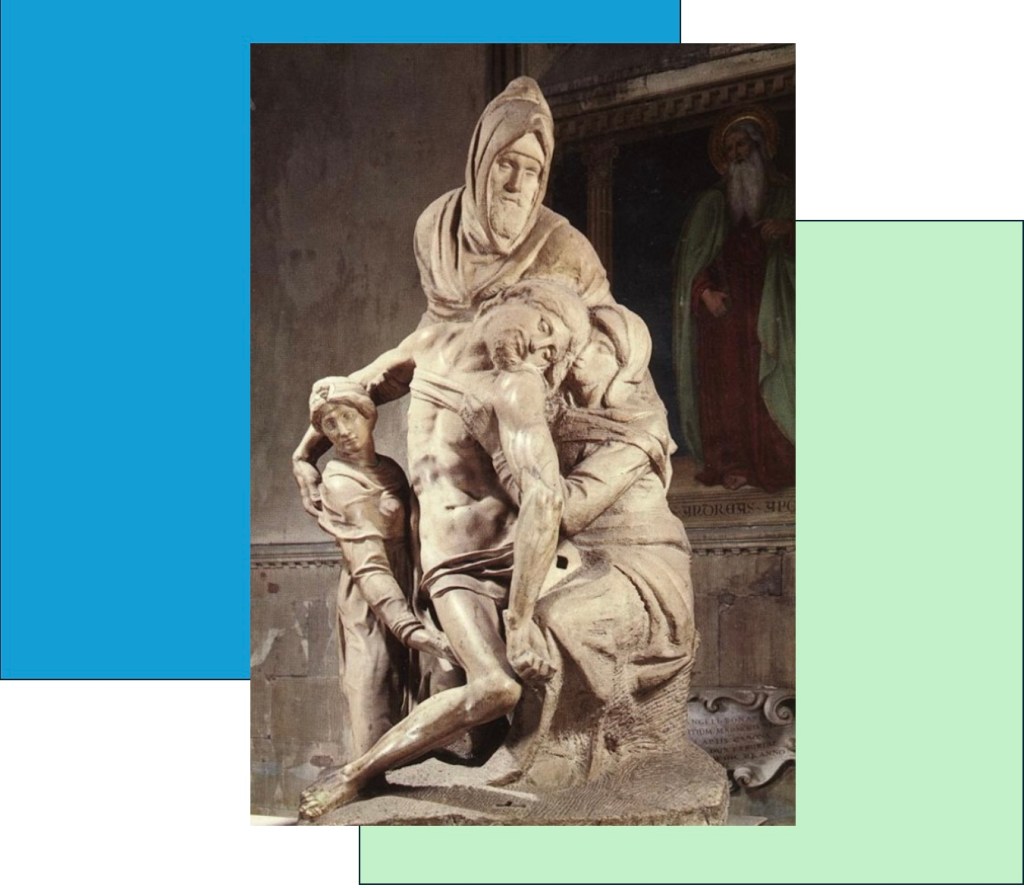
This week read the remarkable story of Nicodemus (John 3:1-21) and see what strikes you. He has inspired composers like Bach and artists like Michelangelo whose piece The Deposition is revered. A picture of it is at the top of this post.
References for this post are from The Jerome Biblical Commentary and The New American Bible.
 In All Things Charity
Leave a comment