Photo Credit: Getty Images
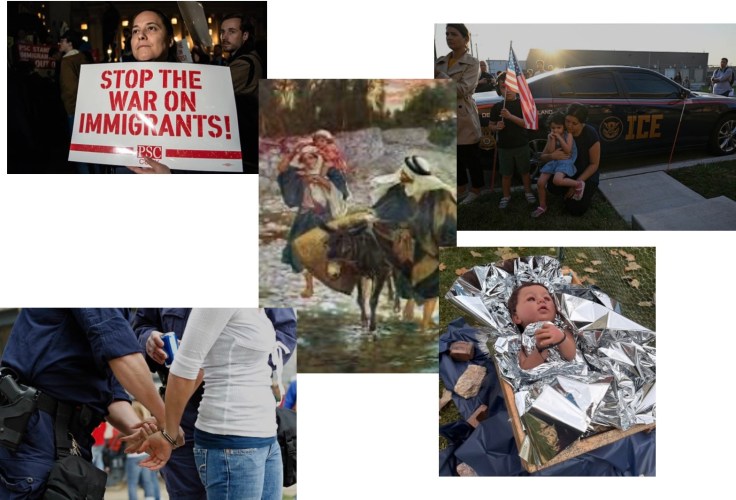
I have been thinking a lot about Mary, Joseph, and Jesus who are ‘on the run’ since Jesus’s birth in Bethlehem. A few historical facts might make their escape more understandable.
Herod the Great (yes, that is his title), wanted to kill the infant Jesus. We know that part of the story. But how does the rest of the story unfold?
Herod was not ethnically Jewish. His ancestors converted to Judaism, probably for political reasons and he was raised a Jew. His son, Herod Archelaus, followed him to the throne and was as brutal as his father who had murdered several wives and sons. In all, Herod the Great had ten wives.
While the Holy Family hid as refugees in Egypt, Herod the Great died. Jesus would have been no more than two years old at the time. Joseph, hearing of Herod’s death, is visited by an angel, again, and told to leave Egypt for the “land of Israel.” But hearing that Herod Archelaus had succeeded his father, Joseph was afraid to go to Bethlehem or Jerusalem, so he set out for Nazareth in Galilee, an area ruled by Herod Antipas, another son of Herod the Great who was not as cruel and chaotic as Archelaus. Antipas is king at the time of Jesus’ death. I think it is very telling that Joseph is prudent and perhaps shrewd in determining where the family would live safely. The life of the Holy Family during their exile must have been similar to the lives of today’s refugees. While they may have used some of the gifts of the Magi to survive, they were still refugees and vulnerable to inhumane treatment as they begged for lodging and food. Egypt was not adverse to Jewish refugees, but it was not beyond exploiting them.
In a recent column in America, Jesuit William O’Neill cited numbers that resulted in the cuts slashed by the United States to aid programs for refugees worldwide. In Kakuma camp over 300,000 refugees have had food rations “reduced to 30 percent of the minimal nutritional requirements.” “According to a United Nations official, hundreds of thousands of refugees are slowly starving in Kenyan camps, a story repeated throughout the world.”
O’Neill cites that one in 67 people in the world is forcibly displaced. By the end of last April, 122 million people were displaced, 43 million as refugees. The costs of such assistance to them from American agencies were miniscule, according to O’Neill, with “only 0.0012 percent of U.S. spending per year.”
Reflection
Reading this compelling article during the Christmas season, one is faced with the similarities between the Holy Family and the refugees of today. Both flee oppression and death. Both flee tyrants and adverse political governing. Both flee religious prejudice and war. Both cherish their children and want a better life for them. Both believe in the infinite goodness of every human being, a goodness caught in the web of craven power and strangled by ambition and cruelty.
I’m wondering what you and I can do to address this tragic reality of the Flight into Somewhere: the journey into another country, a foreign place, a nirvana where good, struggling, families can flourish the way God intends them to flourish. First, we must pray; we can organize folks to join us in our churches or wherever we live: a neighborhood, an apartment, a senior living campus to do this. We can organize study and book clubs. Second, we absolutely must contact our congressional leaders and challenge them to do something specifically about restoring aid to foreign nations where such aid has been cut.
O’Neill quotes Pope Leo in his message for the 111th World Day of Migrants and Refugees. It is a fitting reflection for us now.
“In a world darkened by war and injustice…migrants and refugees stand as messengers of hope. Their courage and tenacity bear heroic testimony to a faith that sees beyond what our eyes can see and gives them the strength to defy death on the various contemporary migration routes.”
Let’s think about this in the week ahead: “they bear a testimony to a faith to see beyond what our eyes can see…” Ask for the grace to see what we do not see—even for all our goodness—that they see. Whatever they see, is of God. We want that rich gift.
Sources: William O’Neill, SJ., “What Have We Lost,” America, December 2025, p. 66.
Bruce Chilton, The Herods, Fortress Press, 2021.
 In All Things Charity
Leave a comment