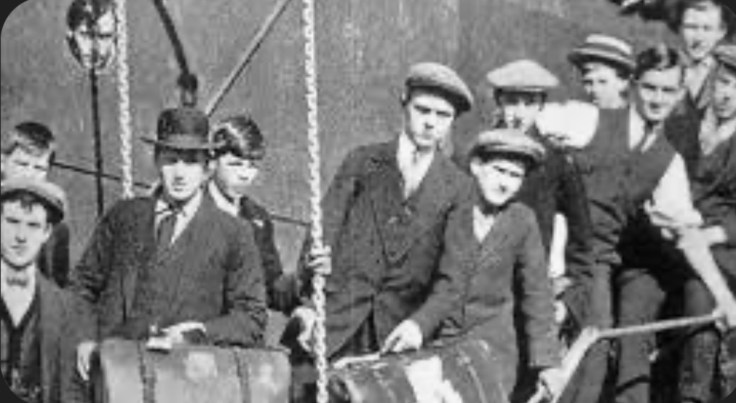
Two of my grandparents and all of my great-grandparents, both maternal and paternal, fled the tragedy of The Great Hunger (An Gorta Mor) that tore apart their beloved homeland, Ireland. I grew up learning about my heritage and enjoying its culture but often saddened by the stories of the experiences my family members went through before they left for America. My maternal great-grandfather lost his flourishing basket making business when the forced potato famine gripped the nation for seven years between 1845 and 1852. He sadly left for America but “left his soul in Ireland,” as my grandmother, his daughter, often said. The Irish were forced to become ‘British,’ to yield British culture giving up their Irish language, and most of all, their cherished faith. They became slaves in their own country. I see this as one of modern history’s painful examples of ethnic cleansing. One million Irish died under this brutality; two million left for Canada, America, and Australia.
Sonja Livingston’s article, “A Great Hunger…” in America, March 2026, touched a nerve that had long been dormant within me. Why had I always dwelt only on the culture of Ireland and the fun of being Irish even after a memorable trip there in 2005 when I saw the monuments and historical evidence of starvation, tyranny, and death from those struggles and wars for freedom? Even then, why did they not ignite a fire to lift me over the years from the romanticism and poetry of my heritage to do something wherever such oppression exists in Northern Ireland or elsewhere in our world?
Livingston joined the 12 mile walk through County Mayo’s Doolough Valley as part of the annual Afri Famine Walk commemorating the millions who died during the famine. “Walking is a desperate act,” said former organizer of Afri, Joe Murray, to the hundreds of walkers. “Think about those who walked in desperation of the past and those who continue to walk in desperation today.”
Murray’s quote stuck with me, bothered me, as did one of Livingston’s who said, “the failure to recognize God in the faces of the suffering was the real blight.” She told of a large group of starving Irish who walked all night to a hunting lodge where British Inspectors were to meet them. The inspectors were lunching when the group arrived and told the gatekeeper to tell the group they could not be disturbed. The poor were clinging to the gates begging for food as the Inspectors left without meeting with them. They didn’t even recognize the poor. The blight of not recognizing the starving says Livingston, “remains with us today. Whether in Mayo or Belfast, Ukraine or Russia, Gaza or Israel, El Paso or Rochester, N.Y., we must do our best to help those who suffer—for their sake, but also for ours.” I’ve been asking myself: Do I recognize the poor? Deep down inside do I truly recognize them?
Reflection
Saint Patrick’s Day is a faith-filled day for me starting with Mass with my brother and his wife; it is a day of visiting other family and, of course, attending the second largest parade in the U.S., just under New York’s. I will feel and hear the spirits of my ancestors as I listen to Irish music. I will listen to Irish poetry and Irish jokes. I will revel in reading Irish stories while recalling the ones my grandparents and parents told us in years past.
This is a good time for each of us to reflect on our family connections to immigration. No matter your heritage, think of your brave ancestors who came here with nothing but a dream and a prayer. And then consider what you are called to do for today’s suffering who are endlessly walking in war-torn countries and starving for food and to be understood and loved by citizens of the richer world.
Another source of reflective reading could be The Book of Exodus in the Hebrew Scriptures. Take note of God’s loving words and guidance through miracles as the Chosen People “walked in desperation.”
My Gaelic words to all of you, faithful readers and Anonymous Angels are mo ghra thu (I love you).
I will have word about my pending eye surgery next week. Please help me pray.
 In All Things Charity
Leave a comment