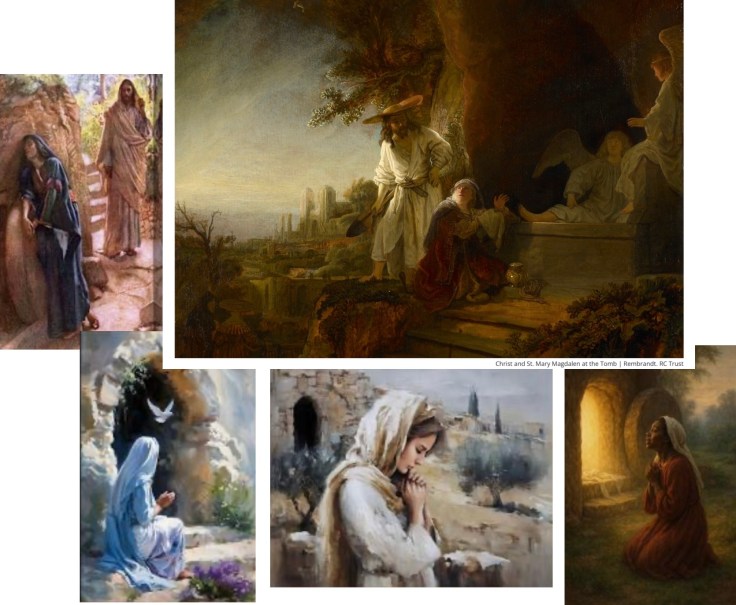
Only in John’s Gospel do we have the poignant story of Mary Magdalene mistaking Jesus as a gardener when she sees the empty tomb on Easter morning. (But remember each of the other Gospels tells us the women were the first to arrive at the tomb that morning. This is an important fact which I will build on further.) After Mary Magdalene and the other women arrive at the tomb to anoint his body, they find the body gone. Mary ran to the apostles to inform them about this and then returned with John and Peter to the tomb. After seeing the tomb empty, the two apostles then “went home” while Mary stayed weeping in deep grief. She peered again into the tomb and saw two angels who asked why she was weeping. As she was speaking to them, a man appeared and asked her the same question. “She supposed he was the gardener and said, Sir, if you are the one who carried him off, tell me where you have laid him and I will take him away.” Suddenly she recognizes Jesus and reports her experience to the apostles.
As I mentioned above, the importance of the women as first to see the empty tomb cannot be refuted claim many scholars. They knew the grave as they had been there the day before to accompany the burial. No one could claim they were mistaken. We might ask why Jesus did not appear to Peter and John while they were at the tomb. Why did he wait to appear to Mary? Most writers say this was, in our modern parlance, a teachable moment, a time not to protect or challenge the leaders of his movement who were all men, but a time to give full recognition of himself to someone who represented the marginalized population: A woman! Jesuit Drew Christenson draws a beautiful analogy of the intimate moment between Mary and the Risen Lord. In a video Christenson says “In scripture, God meets humanity in person twice in gardens. He meets us once in the Garden of Eden and then again in the garden where Jesus was buried.” Christenson implies that mistaking Jesus for a gardener is also part of the analogy. Jesus cultivates our faith, pulls out the tares and weeds, plants the healthy seed. It is as if the story of our faith starts with a garden and ends with a garden. There is no crowning of royalty, no praise of prophets, no promise of power. Mary Magdalene represents all of us. Sometimes we do not recognize him at first because he is so much like us: An ordinary person. But if we feel Christ’s presence or his call to us, if we see him in someone who needs us, well, he is then the gardener reaching out to us.
Reflection
The intimate meeting of Jesus and Mary Magdalene must have been a powerful moment. After she realizes he is not the gardener, she reaches out for an embrace, but Jesus tells her not to cling to him for he has not yet gone to the Father. I cannot list the many writers who debate the meaning of Jesus’s words. How could he have not gone to the Father already? What does this mean? What is John leading us to explore? The use of the word “cling” in John is very different from the word, “touch” commonly used in other translations. What might be the reason John prefers the word, ‘cling’?
Sometimes we look to art for guidance in our interpretation of feelings about something. We can meditate on the garden scene for quite a long time and come up with new thoughts and inspirations each time but if we add an artistic rendering of the subject, we might generate more inspiration. The story we are encountering today is one such subject. I suggest that your prayer will be enhanced if you select a work of art to move you into deeper prayer and appreciation of an inspiring event.
The artist Rembrandt produced a magnificent painting of this holy moment when Jesus and Mary Magdalene meet in the garden. Jesus wears a somewhat comical, floppy gardener’s hat and carries the tools a gardener would have. Mary is excitedly reaching for him and is thus frozen in time exemplifying the gesture so famous for its incompleteness: “…do not cling to me.” The painting provides a wonderful starting point to reflect on the Easter event; it is teeming with meaning. Check it out on YouTube and linger with it.
As you begin your post-Easter spiritual journey spend time with Mary Magdalene. The entire history of the Christian faith rested on her going to the tomb to minister to a dead body and then discovering he is alive and that she is to take his message to his apostles. It is conceivable that we would not have the faith we have today were it not for Mary Magdalene. Reflect on any of the paintings of this event but especially make considerable time for Rembrandt’s interpretation. Let the Easter experience lead you away from “clinging” to the comfortable ways of living your faith to new and lively ways of nurturing it for yourself and sharing it with others. Remember, the message was meant to be spread.
I hope you are enjoying the beginning of a beautiful spring. Start going outdoors and savoring the emergence of new life. I hope you are enjoying new life in your soul! I treasure all my readers and my Anonymous Angels.
 In All Things Charity
Leave a comment