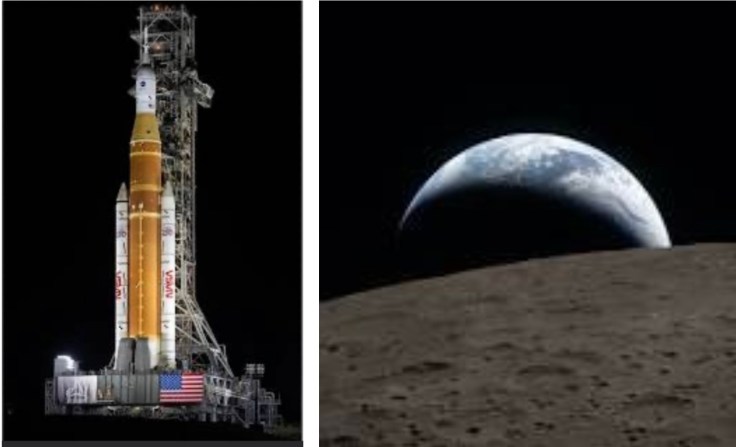
These days I’m ‘over-the-moon,’ so to speak. (Sorry, I could not resist that.) But the journey of Artemis II and its four cabinmates have many people on earth entranced and curious about the universe, its immensity, its secrets, and its life so unlike ours. Millions of us watched the launch of Artemis II with tears for the bravery of the Astronauts and the pride of American achievement. I imagine that school children were mesmerized gazing at the classroom TV as the launch took place.
Artemis is the name of an ancient Greek goddess of the hunt, wilderness, wild animals, chastity, and the moon. The name is fitting for this expedition. However, a previous launch to circle the moon was made by Russia in September 1968 when Zond 5 was launched. The crew of that launch was two Steppe Tortoises along with worms and plants. All survived the successful trip, but Russia discontinued the program.
One of the unique blessings of Artemis II is that we can monitor the daily routines and discoveries made by the crew. This trip will be immortalized as the voyage that traveled the farthest any human has ever traveled in space and provided all of us with descriptions of what our magnificent moon looks like ‘on the other side.’ “Humans have probably not evolved to see what we’re seeing,” said Victor Glover, pilot of the crew in one of his messages. “It is truly hard to describe. It is amazing.” Scientific technology has developed in light years from Neil Armstrong’s walk on the moon in 1968 up to now. We can follow on our computers and read an on-going narrative in some newspapers like The New York Times and in social media.
Reflection
Every day we wake to the horrors of war disturbing our peace like a wild animal groveling at our door. Each of us is disturbed, somewhat agonized when faced with the suffering our fellow human beings are enduring all over the world. It occurs to me that our astronauts are touched by the beauty and cohesiveness of our ‘Blue Marble,’ and from their vantage point, they do not see the evil we are doing to each other. But they know about it and they are sending thoughts of what inspires them about this Earth we must all love and care for. They are sending thoughts that we need to stop the division and encourage unity. Here are just a few of their thoughts which I think we should place in meditative prayer:
About the exceptional beauty and spirituality of beholding other planets, especially the moon, Christine Koch said, “But ultimately, we will always choose Earth. We will always choose each other.”
Challenging Americans to join in some moments of silence when the crew would not have any radio contact with Earth, Victor Glover said, “I would love if we could all agree, that for that time, let’s just be humans. I’m challenging all of us to think more about unity.”
Crew member Reid Wiseman emotionally requested from NASA that a newly discovered crater be named “Carroll” after his deceased wife and he formed a heart with his hands for his children. “This is also about family,” he said. “We’ve got to explore.”
Our faith has always respected the exploration of the universe and the natural world as well for the benefit of the human race. The Vatican Observatory operates under the directorship of Jesuit Richard D’Souza who has said that Artemis II is a “great development.” A Jesuit was one of the founders of modern astrophysics. A Jesuit was the first to map the moon where thirty objects there are named after Jesuits. Former Director of the Vatican Observatory, Jesuit Brother Guy Consolmagn is a passionate advocate of space exploration when speaking about faith and reason. “We Catholics are part of an incarnational religion. We believe God chose to be part of us. Faith and reason bring us to Truth.” Brother Guy sees the voyage as a deeply human and spiritual endeavor.
There are critics of the massive costs for all of NASA, not just for Artemis II. Some would hold that we could feed more hungry Americans and hungry people all over the globe with the resources provided for space technology. We could offer more and better medical treatments, education, housing, any human need begging for help. There are no easy answers to these problems, but we can see that the technology we develop for space science can also help in researching human health challenges, food inequalities, environmental control. We explore space for the good of the human race and must keep at bay those whose interests are for personal enrichment.
I find the messages of the crew of Artemis II to be inspiring and not self-serving. They have caught on to the real reason for the danger they have undertaken; or perhaps it was in them all the while and only needed the journey to bring it forth. “Why do we study astronomy?” asks Brother Guy. “It’s to feed our souls.” It seems to me that is exactly what Artemis II is doing for us.
Note: All quotes from the astronauts are taken from their April 6 narrative to The New York Times. Quotes from Brother Guy were taken from a speech given in St. Thomas Aquinas Chapel, St. Paul, Minnesota, March 17, 2026.
 In All Things Charity
Leave a comment