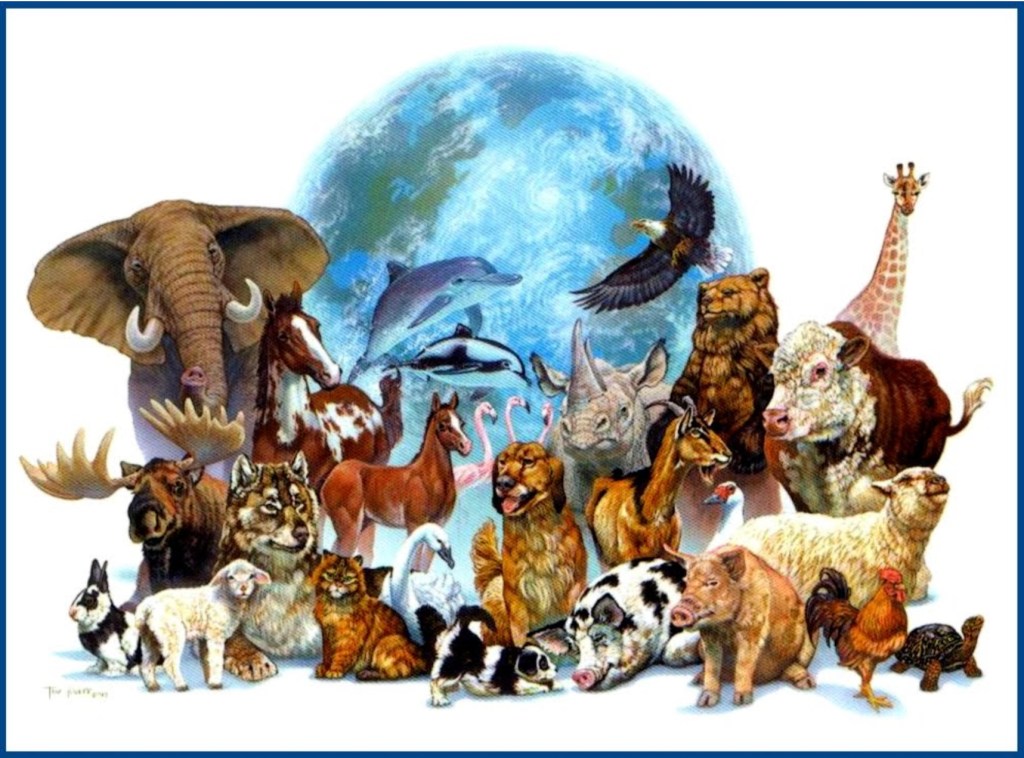
Photo Credit: Pixabay.com
The admired American philosopher, Martha Nussbaum, wrote in an essay titled, “Beings Entitled to Dignified Existence,” about an incident when the “Roman leader Pompey in 55 B.C.E., staged a combat between humans and elephants. ‘The animals perceived they had no hope, and, according to Pliny who recorded the incident, they entreated the crowd, trying to win their compassion with indescribable gestures bewailing their plight with a sort of lamentation.’ The audience, moved to pity and anger by their plight, rose to curse Pompey—feeling, writes Cicero, that the elephants had a relation to commonality with the human race.”
Nussbaum argues that the ethics and challenges of animal rights have always been with us since Aristotle first studied this and urged his students “to look at animals with wonder and curiosity, not disdain.” Nussbaum quotes him as saying, “All animals are objects of wonder for the person who is interested in understanding. If there is anyone who thinks it is base to study animals, he should have the same thought about himself.”
I was reminded of Nussbaum’s cogent arguments as I began reading Ed Yong’s An Immense World, an extremely popular recent book which demonstrates the deeply connected universes of human, animal, and insect. I am only halfway through the book taking notes furiously as I read but I am spell-bound by the dazzling research Yong provides. His interview subjects are equally interesting, and he writes with humor and ease plummeting the depths of oceans, the heights of jungle trees and the labyrinths of strange and mystifying laboratories of scientists. He is the science writer for the magazine, The Atlantic.
Reading this book takes you into the world Yong is describing at the time. The reader grows in a spirituality of awe for God’s creation. Sometimes the anecdotes and explanations of even the tiniest creatures leave me in tears. Every animal, including the human, lives in a “sensory bubble perceiving only a tiny sliver of an immense world.” Yong uses a term for this bubble which came from a German zoologist, Jacob von Uexküll in 1909. The term is umwelt, meaning one’s environment, one’s perceptual world. For instance, if a human were in a room with a spider, a bat, a mouse, a snake and a bumble bee, each creature would perceive the room differently. Each creature would hear differently from the others, each would detect vibrations or movements. None would see the room as completely as the human does; each sees it differently, each would see or not see, hear or not hear differently from the others. In other words, each would be perceiving and working through an individual umwelt.
I began to watch our dog Lily in different ways while reading this book. What is her umwelt? I wondered. When I take her to a different home, the first thing she does is sniff the house from top to bottom. She is establishing her umwelt accepting familiar objects and smells, recanting or being wary of unfamiliar objects and smells. Once comfortable, the umwelt is now safe. Domestic cats offer the same observations when placed in an unfamiliar environment. And what do humans do when welcomed into an unfamiliar place? We canvas the area, notice the décor, observe the color schemes, stopping short of sniffing, of course!
Reflection
Our Christian faith has been maturing into a more cosmological grounding in the last several decades especially with discoveries in all fields of science, archaeology, and theology. We have come to understand that science and theology are dependent on each other. We have moved from a hierarchical diagram of creation in which the human (man) is the top of the pyramid and animals, plants, and other creatures form the lower pyramid. Add to this the the word, ‘dominion’ used in the Genesis story, and you have the elixir that promoted power and reckless unethical treatment of animals and even the denial of astronomical discoveries of recent years. It seemed that if we can’t understand the proof, if our own wealth and selfish tastes are challenged, we can exercise ‘dominion’ and go on ignoring what creation is trying to tell us—we are ignoring at our own peril. It seems to me that all creation, beginning with animals, is begging for help to face climate change and to do what each of us can do for the love of God’s creation.
I encourage you to read the story of Genesis—both Chapters 1 and 2. They are two variations of the Genesis story. Which speaks to you more fully?
On a personal, spiritual level, what is your umwelt? How do you see the world? Is it suffused with God’s immeasurable love? Do you see the natural world and your practical world as united? If not, where are the fractures? Do you spend too much time in the material world and too little in the natural world?
If you enjoy a pet, what can you observe about its umwelt? Can you enjoy that experience with them even at your very, very limited ability? Examples might be to get on the ground with the dog who is sniffing through leaves and pet him as he investigates. Or accept the cat’s ‘prey’ brought to you as an offering and say, ‘thank you,’ rather than, ‘ugh.’
Most of all, write in your journal what you think your umwelt is. I suspect human umwelts are the environments we choose to embrace: artistic, natural, musical, intellectual, and most of all, prayerful. In short, make a prayerful umwelt!!!!
This is Black History Month. I have something for that next week. Plan on celebrating with our Black brothers and sisters.
My prayers and all my love are with all of you.


I love your eclectic reading, thank you for sharing your thoughts with us. I am going to explore my umwelt – wonderful topic for reflection!
LikeLike
Thank you Marge. We walk in the footsteps of human giants and the footsteps of even the tiniest creatures who are also giants to have survived millennia of creation. MAF
LikeLike
I just ordered An Immense World from the library….sounds good.
LikeLike
Enjoy the book Claire. You will be so enriched.
MAF
LikeLike