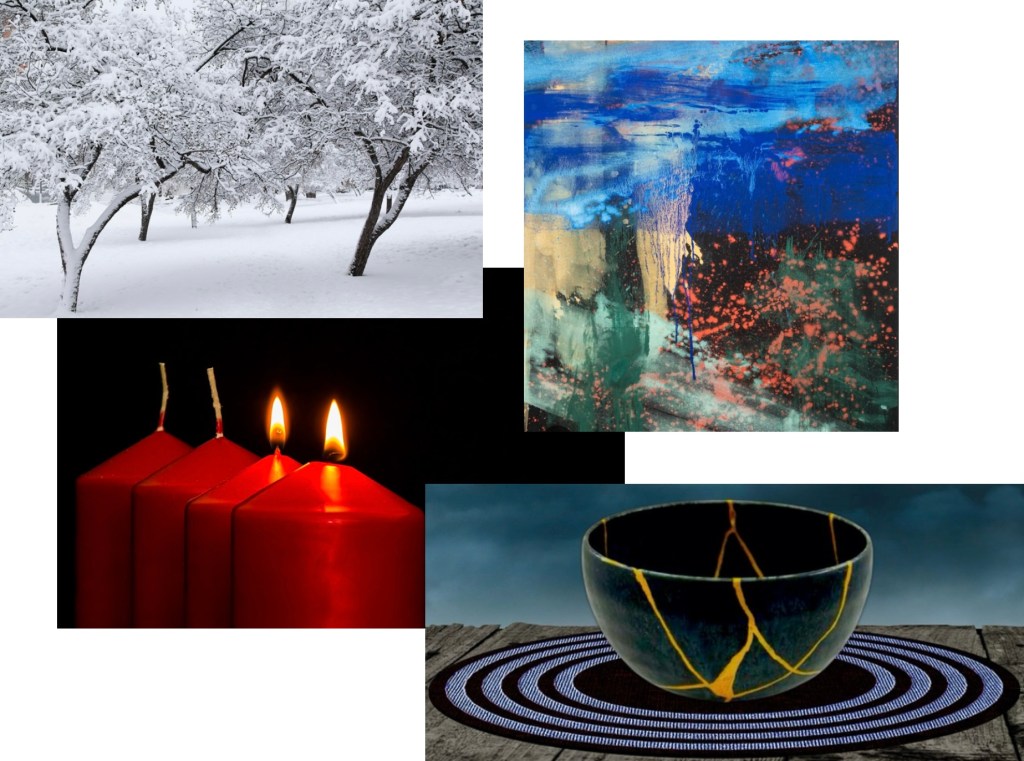
Just now, after our late afternoon walk, Lily (our little Maltipooh) and I have noticed the quiet drifting of snowflakes for what promises to be a healthy snowfall tonight here in our corner of Northeast Ohio. The trees and pumpkins in the yard are dusted with snow looking like sugar on the edges of leaves and stalks and the rounded, full fruit of the pumpkin; the grass is full of sporadic depressions of new snow, pockets of the beautiful. Lily attends to her Umvelt, the region of exploration for every animal and insect on earth which I had written about here sometime ago and I scan the heavy grey sky sensing the coming snowfall. It is early winter.
And I am thinking of Advent and how I might pray better during this time. I am blest to work with and know people who are really inspirational when it comes to accepting different approaches to prayer during special times of the liturgical year. For instance, an artist friend shared with me that she visits an art museum during Advent and Lent and selects a religious section where she can absorb a piece, or several, that will help her reflect and pray on the religious event she is preparing for. Another friend says she takes the days of the O Antiphons right before Christmas and makes a personal prayer for each of these days so that she is better prepared to accept Christ in a mature way at Christmas. She wonders what Christ is asking in each of the Antiphon Days that she can personalize for growth. (The Antiphon Days occur between December 17th and the 23rd.) Other people concentrate on making their own gifts for people important to them. It certainly beats commercialism to invest time and skill in creating something out of love for someone you love. I know of groups who knit or crochet clothing for the homeless. This kind of investment in Advent spirituality is deeply rewarding.
The contemporary painter and Christian philosopher, Makoto Fujimura, says his “artmaking involves greater consciousness, a slower rhythm, and loving attention” because his art is centered on healing brokenness where he finds it. It is contemplative prayer in action. Very much like Advent prayer. Fujimura says that when he is working in his studio, he comes to see his work of healing brokenness as “a profound way of grasping human experience and the nature of our existence in the world.” He calls this experience, The Theology of Making. A shattered cup is made whole; a vandalized painting is given life. Even in the mixing of his paints and working with glue, he thinks he is “practicing a devotional liturgy of sorts.” Through this act, Fujimura says, he begins to feel “the compassion of God for my own existence and the existence of others.” Our journey to God requires not just ideas and information, says Fujimura, but actual making to translate those ideas into meaningful forms.
Another type of art that could be identified with The Theology of Making is wabi-sabi, the art that finds beauty in things incomplete, impermanent, imperfect. In Japanese, wabi means ‘less is more’ and sabi means ‘attentive melancholy.’ Let’s say you find a piece of tree bark about a foot and a half long, maybe four inches high. Not far from it you find an antler which was lost from a buck as he rubbed his head on the tree. These are items commonly found in my yard as we have many trees and a lot of wildlife, particularly deer. You seal the bark with a type of varnish, and you attach the antler. Voila! You have a key ring holder to mount on the wall adjacent to your door. You have made two broken pieces of nature into a whole function. You admire the beauty of broken, unfinished things. The spirituality of this experience is that you realize how much God loves your own brokenness and can make it beautiful, if you work with God.
Making Christmas gifts from remnants, dissembled pieces, discarded items can be fun and it is often a year long project. But you have put your heart and creativity into it just as God did when making you. The depth of wabi-sabi is that it teaches us to accept our imperfections as we recognize and work with imperfect material to make something whole. Another Japanese art form that centers on brokenness is called “kintsugi” in which the artist retrieves a broken piece of pottery or ceramic and repairs the piece. The idea is not to conceal the broken lines but to glue them in place and then paint the lines with gold or silver powder. You will create a stronger and functional art piece whose scars are highlighted as beautiful and not hidden or camouflaged.
Reflection
Jesus was born into a broken world, very much like our own. Human misery was a flourishing reality when it came to oppressing the Jews whose tiny population and fidelity to monotheism made for an easy target of anti-Semitism by the Romans and other political governments. God wanted to heal this brokenness and Jesus became the messenger. For this week, I suggest you choose any or one of the following Advent practices to prepare your heart for Christmas, to enliven the creativity within you, and to help heal a broken world.
- Encounter the broken by taking gifts to a homeless shelter.
- Make something for a family member.
- Visit someone in a nursing home.
- Are there broken lines and scars in your soul? Think of ways to heal them and take action to do so.
- Get involved in creative gift-making at least for one or two individuals.
- Compose some Advent prayers that center on the brokenness of this world. Ask for God’s help in trying to heal some of that brokenness.
I am including all of you in my advent prayers. I wish you well as you reflect and decide what you can do to make Advent meaningful for you…
 In All Things Charity
Thank you sister for these tangible and thought provoking suggestions to strengthen my Advent journey.
LikeLike
Thank you Anne. I wish you success in making Advent different this year. S. MAF
LikeLike
Good Monday morning Once aga
LikeLike
Thanks Betty–I appreciate your reading the blog.
Blessed Advent. S. MAF
LikeLike
I may visit my brother in Akron on the 16th, so I will have to miss the Women’s Prayer Group at the Jesuit Retreat Center from 9:30-11:30am. Thank you for all the good ideas, and for the Advent retreat day last Saturday at St. Francis deSales Church. take care, Margy
LikeLike
You are kind, Marge. Nice to see you at the retreat. Enjoy a blest visit…S. MAF
LikeLike