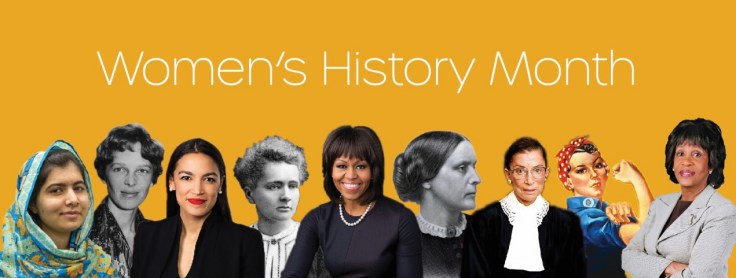
Photo Credit: The University of Akron
March is National Women’s Month. I know some people wonder why we celebrate women this month and it’s a fair question if your knowledge of history is a bit shaky. In the wonderful musical, My Fair Lady, professor Henry Higgins confesses to loathing the incursion of women into the lives of “ordinary men.” In his proclamation that he is an “Ordinary Man,” the song that highlights supposed male superiority and the nuisance that a woman can make intruding into this superiority, one can tell he is weakening at the attraction his protégé Liza presents. In the song, Higgins protests too much, to paraphrase Shakespeare, along stereotypical descriptions of a woman. He states, “a woman will have fun overhauling you,” and maybe, “she wants only to talk of love,” and end up “doing exactly what she wants.” In short, letting a woman into your life, well, “your sabbatical is through.” The song reflects that Higgins cannot face the fact that the vagrant street woman, who found her true self by his very own education of her, would challenge him to find his true self by falling in love with her.
Ah, the kernel of what true love is—changing each other to be the better persons God created us to be.
That is what each of America’s designated months for certain populations is meant to be. In our country we celebrate, in addition to Women’s History Month, Black History Month in February, Native American Month in November, Asian American Month in May, Hispanic American Month in September and Arab American Month in April, Gay Pride Month in June. I know there are more.
Despite the clamor over DEI in recent months, we need to explore what the meaning of these months or periods of time means for us as Americans who welcome all for the growth and prosperity of our nation and the bonding required of us as Christians to one another. Our deep call to kindness and love requires a courageous look at all our different populations growing among us everywhere today.
Women are probably the forerunners of minorities who sought equal rights in our nation and the odd thing about this is that they were not a minority—they were one half of the population! They were mostly wives of men, some of whom were influential. My own maternal grandmother could not vote as a young married woman in Pittsburgh, Pennsylvania. She had been born in Ireland and knew of the injustice of not allowing poor Catholic people in her Northern Belfast County to vote. She would not stand for it here when she learned women could not vote in America; she became a suffragist and fought for the right for women to vote finally approved by Congress in 1919 when her daughter, my mother, was one year old. I was startled when I saw that my grandmother’s mother, also an immigrant to America, could not sign her marriage certificate in Ireland because she was illiterate. She and her bridesmaid placed an X next to their printed names each translated by the pastor as “her mark.” On one of the census rolls I found in genealogical research; my great-grandmother was again identified as “illiterate.” Only three generations removed, I was working on my doctorate when I noted this designation. I wept.
Over the years I have studied how the rights of ‘submerged populations’ were systematically left out of roles in all professional fields and denied simple rights like, in the case of women, purchasing a car without a male co-signer, or opening a bank account without a husband’s or father’s signature or being denied a job even if one was more qualified than the male applicants. All of this in my lifetime! But women became more resourceful to succeed in virtually all careers sometimes raising children alone at the same time. They organized and protested and rallied and eventually the restraints in hiring practices were lifted recognizing not only the rights of minority groups but enhancing the economy where these hirings were implemented. The Civil Rights Act of 1964 became the law which assured all minorities of their rights even though the argument for women’s rights was not entirely clarified or secured. It took several iterations of the law and a final amendment to secure these rights for women by 1965.
Sharon Welch was a Harvard professor of theology who coined and defined the term “subjugated knowledges.” Put simply, it means that minority populations are invested with social, intellectual, and practical wisdom or knowledges of life which the majority population keeps under control by suppressing speech, denying education, withholding rights for employment, isolating and segregating the groups considered inferior. Thus, without realizing it, the majority population is weaker without this knowledge, much like the pompous Professor Higgins. He treats Liz Doolittle’s demeanor and language as inferior, something to be overcome while failing at first to see the woman beneath the exterior. The Civil Rights Law retrieved the voices of women and all minorities and by doing so surfaced the lived experiences they could then share with the rest of society. That would be Sharon Welch’s whole point. I have applied her theory in many discussions and lectures on human rights. The conclusion of it all is we need to learn this wisdom from the minorities among us.
Reflection
When I taught in an all-girls high school in the 60’s mostly, I would see fathers of the girls driving them across town to attend our school. One of these dedicated Dads said to me: “We want her at a school where women are trained to excel.” I meditate on his words then and now.
Thank and praise God for the women in your life, women you knew and loved like your mother, grandmother, aunt, neighbor, teacher, friend – any woman who challenged you to be better than you were or who drew you out of yourself and loved you totally for who you were and are. They are the women on whose shoulders you stand! They are the reason to celebrate Women’s Month.
 In All Things Charity
Mary Ann, Thank you for this personal and historic perspective on the hard-fought struggle for women’s rights. I was especially struck by your realization that your great-grandmother was “illiterate”–and that you discovered this fact while you were working on your doctorate! That sentence strengthened my hope for the future. I also appreciated your suggestion that we give thanks for the particular women who impacted our own lives in so many different ways. Thanks again for a nourishing reflection! Melannie
LikeLike
Dear Sister Mary Ann
I love this blog! I am the daughter of a mother and granddaughter who survived WW II. My mother and her family are from Germany and they suffered terribly during the war and afterwards. The present war between the Ukraine and Russia brings back memories for my mom and her siblings.
Thank you for sharing this wonderful reminder to honor the Women in your Life! With faith, hope, love and many blessings, I remain always your friend. Betty
Betty Hickle (216) 905-1750
LikeLike
My mom’s mom died when she was 7, so I never met her, but she and my Irish grandmother were treated as second class citizens at best. My mom told us stories about her struggles, trying to be respected and treated as the wonderful woman she was. My aunts and uncles were all valued by us, even when society didn’t acknowledge their worth. Thank you for your wonderful blog!
LikeLike