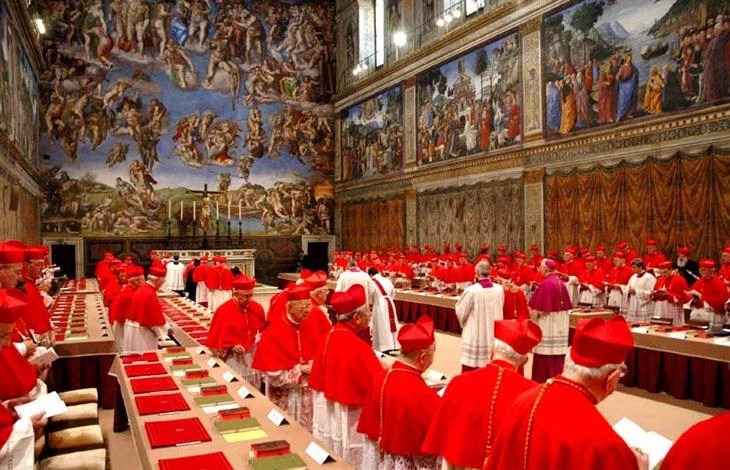
Photo Credit: Sistine Chapel
Yes, there has to be charity in the process of choosing a pope. You would think that an assembly of men who are leaders in the Church and should have the good of the Church—all its followers, all who take solace and encouragement from its guidance, and yes, all who seek to learn and know more about Jesus Christ and hope that through this following they can make the world more loving and hopeful–yes, that these men who represent us, who ostensibly know us, will meet to elect a pope who can do this for and with us. You would think. But conclaves have their human element which cardinals are asked to rise above as they consider their candidates. Some do this better than others but, thankfully, we never know who these persons are during the process of voting.
According to the late scholar, Fr. Richard P. McBrien, “The papacy is the office of, and the jurisdiction exercised by the Bishop of Rome, known more popularly as the pope. The pope is “the one who personally succeeds to the distinctive ministry of St. Peter for the sake of the universal Church.” (p.404) For the first 1,000 years of the Church’s existence, the clergy and the people of Rome elected the pope “because before all else the pope is the bishop of the local church, or diocese of Rome.” (p. 405)
The history of popes for the twenty centuries of the Church provides insights into the history of the Church itself. These men were “warriors and peacemakers, saints and scoundrels, politicians and pastors, reformers and nepotists alike,” says Fr. McBrien. (p.1) History has provided us with biographies of over 260 popes; some were anti-popes, some religious charlatans who claimed the distinction in place of the rightly anointed one. Most of these unsavory characters were pawns of political dynasties and/or inebriated with their own personal wealth.
Why is the Conclave secret?
The word ‘conclave’ means ‘with the key’ in Latin, an affirmation that the pope holds the keys of St. Peter in discharging the practice of the faith. The vote is secret because the pope will hold the key to the Catholic faith in its research and explanation of the doctrines of the faith. It’s a beautiful image if you think on it. A key unlocks the door to treasures whether it be your home or your office or even your car! The conclave unlocks the will of God for the future of the faith. Politics and the vote? Consider that cardinals represent many nations so politics will influence them but from a point of view that their people must be held up and brought to the fullness of Christ’s message for all believers, especially the poor and oppressed. Historically, cardinals were approached by powerful government leaders to vote for their interests. But, in more recent centuries we have moved away from that position and a pope elected from a less powerful, less wealthy nation would be expected to reflect the culture and people he was serving as a leader of the Church. So, yes, politics will influence the voters. I think this is a good frame of thinking for each cardinal who sees the suffering and the giftedness of the region he represents and just as firmly sees the needs of a global Church.
That is part of the reason for the secretiveness of the conclave. However, the most important reason for the secretiveness is so the cardinals can think and pray to the Holy Spirit, without distraction, for the candidate they choose.
What are ‘cardinal-electors?’
In 1970, Pope Paul VI decreed that only cardinals under the age of eighty are eligible to vote in papal elections, with the maximum number of cardinal electors set at 120. There may be more cardinals but only the 120 can vote. Unlike centuries past, papal elections now take place in the Sistine Chapel and cardinals reside in the newly constructed Domus Sanctae Marthae, a guest house and the place where Francis chose to live after being elected. The elections begin 15 to 20 days after the pope’s death and usually they last only a few days. In the 13th century, cardinals were warned if they didn’t complete the voting within three days, their rations were to be reduced for five days. If they still had not decided on a pope, they would be given bread, wine, and water until they elected a pope. These punitive measures were in reaction to prolonged conclaves, some lasting many years!
Reflection
The next pope, like him or not, is traditionally called The Vicar of Peter who “keeps the faith alive as it was handed on to him.” (p. 33) McBrien says “he is a substitute, but does not replace Peter.” He can’t. He is not one of the original apostles and he did not see the Risen Lord. The pope is The Vicar of Christ insofar as he is a bishop, not insofar as he is pope. Despite his titles, the new pope will realize one, humble description which gets little attention. He is the “Servant of the Servants of God.”
We must all pray for this election. Consider that the world is becoming more authoritarian, more selfish, more bellicose, more fearful. We pray that our new pope will address these concerns through the teaching of Jesus along with respect and appreciation of other faiths and their leaders as well. McBrien encourages us to think of the words of Jesus captured in the following Gospel passages and pray that a new leader will continue what Pope Francis and his predecessors had started so that we may grow as a loving Church open to journeying with all other faiths, to healing divisions, to creating peace, to fostering understanding among our differences. May we welcome a pope who will teach us how to be ‘servants of God.’
Fr. McBrien suggests these passages: Matthew 16:13-19; Luke 22:31-32; John 21:15-20.
We should reflect on these passages and pray for greater understanding of the ministry of the pope.
All information and quotes for this post came from Lives of the Popes by Richard P. McBrien, Harper San Francisco, 2000.


Thank you for the Scripture references for prayer. Very appropriate for what we need from a new pope and leader. God bless you and all of us as we pray for the Spirit to work in the Cardinal voters
LikeLike