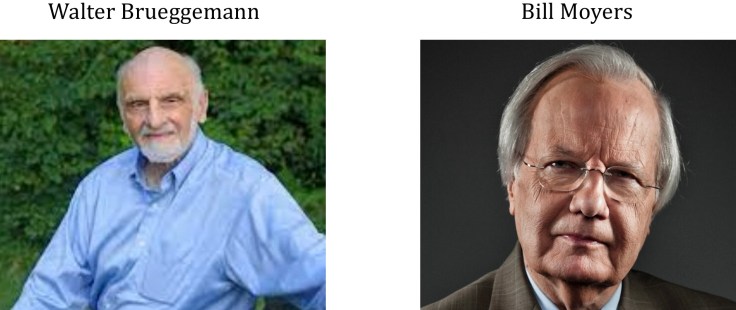
Photo Credit: The New York Times
On June 25, just a week ago, we lost Walter Brueggemann, an American theologian and well-known scholar of the prophets in the Hebrew Scriptures. A few weeks before Brueggemann’s death, the respected minister-turned journalist, Bill Moyers died. Both men were in their early nineties. Both were Southerners. Both wielded a saber against the dull consciences of political leaders and the soft banality of much of the American public. Brueggemann remained a life-long teacher, writer, and researcher of biblical texts publishing over 100 books while Moyers folded his theological training into journalism claiming that when it came to ‘the call,’ he received the wrong number. Neither man shepherded a parish though Brueggemann was ordained into the United Church of Christ, and Moyers was ordained a Baptist clergyman.
Brueggemann is best known for his magnum opus, “The Prophetic Imagination,” published in 1978. The book is based on his lifelong study of the prophets and their vocation “to keep alive the ministry of the imagination, to keep conjuring and proposing future alternatives to the single one that the king wants to urge as the only thinkable one.” It is not a tedious theological tome and is quite brief for such a powerful message. Brueggemann was “fiercely critical of American consumerism, militarism, and nationalism.” It has been noted that “he sought to help pastors hear God’s voice within the biblical text.” He consistently held that the prophets “had no pedigree.” They were ordinary. They merely imagined their world in the tradition of the Jewish heritage and yet, in each instance, “power people tried to silence them.”
For Walter Brueggemann, the bible “calls us to be at unease.” When we do not choose this direction, this unease, we choose a “path of death, commodity, violence.” He perceived that the prophets in the past and today are “emancipatory but not ideological.” In other words, they touch the core of faith in all things justice but do not wear the cloaks of political parties.
Bill Moyers caught the eye of Lyndon Johnson before he became president when Moyers was carving a career as a political correspondent. He became a key architect of Johnson’s The Great Society and an organizer of the Peace Corps. He later became LBJ’s press secretary. One of Moyers’ greatest concerns was that of “big money eating democracy.” To him, “journalism was a calling where the goal was getting as close as possible to the verifiable truth.” Thus, his best-known work was at PBS where he enjoyed the latitude to probe deeper into the vexations of American and global governance through interviews with key leaders and discussions of major topics that challenge and threaten our world. He once said, “Leaders are afraid to say this is where we need to go and this is how we get there.” Familiar with the existence of evil and its constant, slippery moves to convince us to accept the cunning of the Father of Lies, he said, “When neither people nor leaders are willing to face reality, nations can die of too many lies.” He was skeptical about a democracy succeeding if the country “doesn’t tolerate good journalism or prophecy in the pulpit, or truth-telling in the classroom.” One of his last thoughts, shared with Eric Alterman, a CUNY professor, was, “I’m deeply troubled by our lack of debate in the country by suppression of dissent, by the secrecy.” Moyers lived a retirement full of new enterprises producing documentaries and videos and ultimately, President of the Schumann Center for Media and Democracy which offers grants to transparency watchdogs, non-profit journalism, and environmental journalism.
Reflection
I find the lives and work of these titans of faith and government teeming with guidance and example for us today. Though they never pastored a church, they pastored thinkers, readers, teachers, leaders in our country with their scholarship and ministry. They lead us to wonder where our faith leaders are today. Where are the prophets, those who have a platform, and why do they not speak truth to power? Brueggemann believed that pausing to listen to God’s voice results in something transformative—you and I become transformed for the greater good; we would be getting closer, says Moyer, to “verifiable truth” and we would act on it.
Our country is reeling in a disgusting division. You and I need to be doing something to help heal this and not foster it further. Yes, speaking up and taking action will cause further disruption but if enough do it, somewhere the ship begins to establish an even keel. I pray we can do this.
So, why not read what you can of Brueggemann and Moyers. They can also be found on YouTube. I urge you to read The Prophetic Imagination. You might also want to read the work of Martin Luther King. A current faith leader, Bishop William Barber, is an outstanding leader speaking truth to power. Check him out on Google. Two Roman Catholic Bishops who are leaders in the immigration ministry are Mark Seitz of El Paso, John Wester of Sante Fe. Seitz has sent a letter signed with leaders of other faiths to every member of Congress protesting Trump’s recent bill and Wester has written a letter titled, “Let us Not be Silent.”
Cardinal Robert McElroy of Washington, D.C. and Bishop William Tobin of New Jersey are also leaders in the quest for justice. I suggest we do two prayer activities this week: First, read and reflect on what you glean from Brueggemann or Moyers and any of the Church leaders I have mentioned. You will have to google them but perhaps you can order Brueggemann’s book on “prophetic imagination.” Second, as you read, let yourself be brought to prayer for inspiration on what you can do and share your idea with another person. You will be surprised how this will make you feel optimistic, and hopeful about our cherished democracy. It will be the start of your ‘transformation.’


Mary Ann,
This is excellent! Thank you! Thank you! I too am familiar with these two great men, and you have encouraged me to re-read some of the masterful things they have written. These sentences in your blog stood out for me: “nations can die of too many lies…” and democracy has a hard time surviving if it “doesn’t tolerate good journalism or prophecy in the pulpit, or truth-telling in the classroom.” Wow! How sobering are those words. And finally, thank you for directing us to people like Fr. Mark Seitz and Bishop John Wester. I’ve already read Wester’s powerful letter “Let us not be silent.” Thank you for your prophetic voice emanating every Monday from Bedford, OH! Melannie
LikeLike
Thanks Melannie. Glad you find these two thinkers as inspiring as I think they are. I’m also happy that much about them is available on the internet. All of us should look up the other religious reflectors as well. We. need to learn about our faith through persons who are ingrained in the prophetic voice of faith. Blessings on your work, too, Melannie…MAF
LikeLike
TY for this informative & inspirational article. I had forgotten how much insight & positive influence Moyer had in journalism & politics.
LikeLike
Thank you Augusta…Moyers was ethical and reflective and gave journalism a good reputation. Being ordained a minister seemed to have helped! Blessings to you. S. MAF
LikeLike