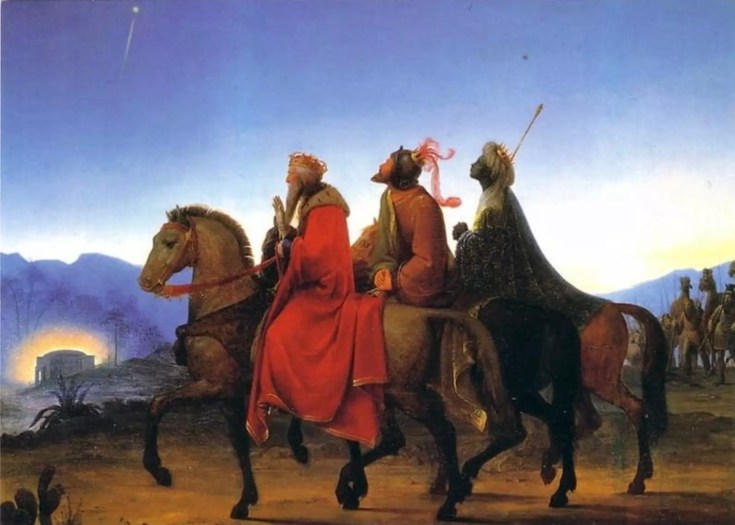
Photo Credit: Bible Study Tools
We’re about to celebrate the Feast of the Three Kings, or Epiphany, as the Church calls the event. Here’s what we really know about these men and what they can teach us. First, there may have been—and probably were—more travelers in the group. They traveled from Mesopotamia, the home of astrology in the Hellenistic (Greek) world. Their study of the stars is called astrology because there was no scientific study called astronomy. No doubt they had business in Egypt and while there saw the strange star which they had to trace. They were astrologers, not scientific astronomers, because they connected strange stars as related to earthly phenomena. We say there were three of them because only three gifts are mentioned in their visit to the birth scene. But historians suggest that there were more people with them since the journey was long and their camels had to be loaded with provisions and equipment.
Second, because they came from the East, they are the first gentiles to whom the Christ is presented. Thus, Eastern religions have claimed the Three Kings as their feast of Christmas. According to most scholars, they were a learned priestly caste of Persians but still others say they were skilled in occult knowledge; thus, they were called, ‘magoi,’ or magicians. It is easy to understand why their knowledge would be so questionable since most people knew almost nothing about stars or the universe. I believe they were scholarly students of the stars and probably knew quite a bit of rudimentary information about the heavens. They were not Jews and may have been pagans. But they were open-minded. Somewhere along the line of hagiography or legend, they were given names: Balthazar, Caspar, Melchior.
The scripture, according to Matthew, is not clear how Herod found out about the Kings but he “called them to him and found out the exact time of the star’s appearance. Then he sent them to Bethlehem, after having instructed them: Go and get detailed information about the child. When you have found him, report it to me so that I may go and offer him homage too.” (Matt 2:2-9) We know the Magi went on and were “overjoyed” when the star led them to the place where the Child was in Bethlehem. Later, they receive a message in a dream: “not to return to Herod, so they went back to their own country by another route.” (Matt 2:12)
These men, these seekers who found the Christ, have become the models for all seekers in generations to come. How? They are curious about the science and lore of the stars they study to pursue the direction of that star. They knew, from their charts and configurations that this star might lead to a birth of a very important ‘king,’ or ‘messiah.’ They did not believe in him as a savior—but something happens to them as they pursue him.
Now, think of this: One man pursues him out of envy, pride, vengeance. He will kill him as a child. No one can be king but him, the man who angrily pursues the Child. Then there are the three men who pursue the location of the Child out of curiosity, the phenomenal signs of a star and the discreet, hidden location of where the Child is with his parents. They simply must find him. And they do. Their calculations have been correct. This is a miracle in itself. That these pagan scholars could locate this Child in the dusty haze of a Middle East winter, could recognize him as special, could kneel at his feet, and offer gifts—without any Jewish faith to lead them—is miraculous in itself! And then, they receive a message in a dream not to go back to Herod, “so they went back to their own country by another route.” (Matt 2:12)
I like to wonder how their lives were changed after this experience. Did they follow the news of Jesus’ life as he grew into his ministry? Did they share their experience with other non-Jewish associates? Did they continue to study the stars and look into the faith of Judaism, or did they realize that they, too, were among the saved for whom this Child had come? They had more to learn about faith, God’s love, and their own journey from Bethlehem onward. I believe they did just that.
Reflection
The story of the Three Kings is the story of seekers—like you and me. The key is that we must seek our happiness in God. In humility, we offer our gifts of love and ask him to guide us as we journey. We acknowledge that we need Him. Once we give the gift of ourselves, we will be led to greater happiness and fulfillment. No despot, no alluring persuasions, no amount of riches will change our route. How relieved and happy the Three Kings were on their way home!
To give the gift of oneself to the Messiah, is to assure total happiness on the way home.
What does this story say to me? There is a message in it for everyone.
Can I follow any signs and messages in this coming year that will lead me closer to God’s will for me? How can I find those messages?
I wish each of my readers a blessed New Year and the joy of the Three Kings who found a journey to God by being open to all his messages to them.
 In All Things Charity
Dear Sr. Mary Ann,
I Loved this story.
Thank you
Happy New Year
LikeLike