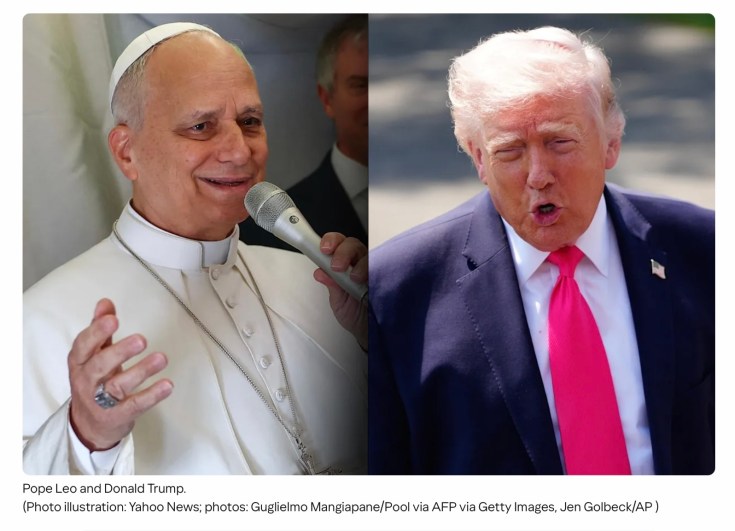
Ordinarily I do not take a side when it comes to politics although my arguments probably leave very little room in deciphering what I think on a certain issue. This is probably true regarding the recent backlash among politicians regarding Pope Leo’s statements on the war in Iran. First, I must underline that I am not an ecclesiologist, meaning a student or scholar of ecclesiology, the theology of the church. Nor am I a church historian. Scholars who work in these fields delight me with their writings (one of my favorites, and I highly recommend him, is the late John W. O’Malley, S.J.,) but I’m really a scavenger among this immense field of faith and theological learning.
One does not have to be a theologian-scholar to address the recent kerfuffle between Pope Leo and President Trump. Most average-informed Catholics understand the basis of the ‘Just War’ theory which, put simply, is “…a defense against another who actually wages war.” (Bishop James Massa, The New York Times, p.10, April 19, 2026) Waging war means starting a war. Massa added, “When Pope Leo speaks as supreme pastor the universal Church, he is not merely offering opinions on theology, he is preaching the Gospel.” The theology of the Just War dates as far back to St. Augustine. In the 13th century Saint Thomas Aquinas developed the theory into two sets of criteria: “one for going to war and one for continuing to participate in war.” “We reluctantly will take up arms as Christian believers, if we are facing an aggressor, and it has to be an imminent threat,” said Massa. The Pope was very clear explaining the Just War theory to a gaggle of reporters on a recent flight when he said, “(God) He does not listen to the prayers of those who wage war.”
The Pope must keep in mind all people who suffer in any given war, both Christian and non-Christian. Jesus would make no distinction between or among different religions and Leo must give witness to that. Thus, he speaks out for everyone. He is also educated on the analysis of scripture; he does not impose the literal translation where dystopic interpretation is sometimes violent or hateful. Our Secretary of Defense defined the “conflict with Iran as a ‘holy war’ trying to put God on the American side as our troops are asked to rain death and destruction from above on “apocalyptic Iranian foes.” On X, the Pope wrote, “God does not bless any conflict. Anyone who is a disciple of Christ, the Prince of Peace, is never on the side of those who once wielded the sword and today drop bombs.” (The argument that a nuclear bomb must never be in the hands of an evil regime is very true. However, even our highest officials claim that Iran does not have a nuclear bomb, but they have the capability to enrich uranium which leads to the bomb. This is where reasonable negotiations are required, negotiations which were operative under past administrations until Trump tore them up.)
Is the Pope speaking from his ‘lane?’ Absolutely. This is his job. Even if one argues he should stick to theology, this istheology. Theology teaches us to oppose what is evil, to protect what is good, to love all people and to negotiate for their welfare. We need a champion to lead us in such an endeavor. I would challenge any opponent to go toe to toe with the Pope on the responsibilities he has to address, in the name of Jesus, such as the atrocities that an unjust war brings on innocent people.
In her article, “The Pope Bedevils Trump,” The New York Times, April 10, 2026, p. 10, Maureen Dowd wrote, “In a puerile fit of apparent retribution on Thursday, Trump canceled an $11million federal contract with Catholic Charities in Miami to house and feed migrant children coming to America alone.”
Reflection
Over and over many of us keep claiming that we do not want to hear the news. We might turn off our television sets or refuse to read newspapers. But, to make our prayer come from the heart, we need to know what is happening. We need to bring to prayer the children we see crying for safety in Ukraine or for food in Gaza and Iran. We have to realize that our decisions as Americans affect the world and we realize this better by being more informed, by seeing the faces of the afflicted, some who are afflicted by our policies. We need to know that aid was taken from children in Miami who came upon our shores, alone.
We need to enlarge our prayer. When we pray for Pope Leo, we need to accompany it with knowledge of what he is saying and doing as our faith leader. The same would be true of our president and congress. Allow the pain you observe to become part of your prayer. Let it soften your heart to help you understand what is happening in our world. Are there Biblical passages you can reflect on that might lead to openness? If you take your scriptures and explore, I’m sure you will find plenty.
I will join you in praying for Pope Leo as he tries to navigate the perilous seas of political reality through his preaching of the Gospel.
Quotes are taken from Elizabeth Dias, “America’s Political Leaders Argue with Pope Over ‘Just War’ Theory” The New York Times, April 10, 2026, p. 10.


Leave a comment