Many years ago, a young priest said Mass for us and preached on forgiveness since that was the subject of the gospel reading for that day. He closed the book and leaned forward saying to us: “I have lived this gospel.” It turned out that his mother, father, brother, and he left for a mini vacation. One brother, the oldest, stayed home because he had just taken a new job. He would watch the home for any unforeseen problems. Before the vacation was over, the family was called home. An emergency said the police. A robbery had taken place at the home, and the oldest son was murdered in the process. Father John could not describe the wrenching pain his family suffered. For years, especially during the trial of the young murderer, wounds were ripped open again and again. Finally, one day the father said: “This is killing us as well. God does not want this; we can do something about it.” They decided as a family to visit the man in prison. They took a bible for him. The visits became regular and the bible sharing turned into lessons of faith and finally conversion to the faith. The family forgave the young man and gradually all became healed and recognized their common humanity.
I thought of this story when I heard of the horrendous experience of the attempted execution of Christa Pike, 50, a few weeks ago in Tennessee. Pike is the accused killer of a fellow classmate, Colleen Semmler, and the first woman who was set to be executed in Tennessee in 200 years. Pike was 18 years old at the time of the murder and her then boyfriend, who participated in the murder, was 17. Pike was thus eligible for execution, but the boyfriend wasn’t.
The details of the murder are beyond horrendous; they are the descent into hell, the fuming sulphur of evil that possessed three teenaged people (a third accomplice was present) to kill someone. I’m quite sure that there will be books written about this murder and the trial because of the many complexities in it. This story, along with the publicity surrounding the proposed public execution of the Fort Hood shooter and the seemingly constant news of mass shootings, have brought many of us to the threshold of paranoia, anxiety, and distaste. How should we look at this?
Our faith teaches us much about retribution, restitution, and justice. But it says, nowhere, that death is an acceptable form of punishment. No crime, especially murder, is placated by the killing of the murderer; a life sentence without parole might be the maximum punishment. The process of administering the drugs in Pike’s case took a total of nine hours because of interruptions of court appeals. According to reporters who are allowed to sit outside the chamber, the curtain opens and closes several times, and Pike can be heard talking when she was thought to be dead. A total of 7 needles were used to inject Pike twice. A third injection is prohibited. We can’t keep injecting until death occurs. She is now in the prison hospital, conscious and aware.
Reflection
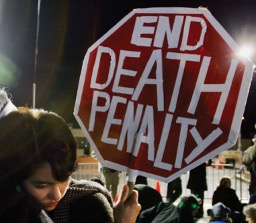
We are the only civilized nation to legally uphold the death penalty, and countless organizations oppose it fiercely. Most of the reasons for opposition are: 1. An innocent person could be put to death. The recent advances in forensics and science have proved this possibility. This is called The Irreversibility Argument. 2. The death penalty is unequally enforced. More persons of color are executed than are white persons for the same crime. Money is a major factor here as well since white persons can afford better legal counsel than persons of color 3. Maintaining death rows in prisons ismassively expensive. In the State of Ohio alone, maintaining a death row can go from 116 million to 384 million in an annual budget for pre-trial work, trial and jury selection, upkeep of the prisoner, court costs, etc. 4. Morality of the execution. Countless philosophers have argued against the death penalty from Aristotle to modern thinkers. Our Christian faith bases its teachings on the mercy of Jesus. Over and over Jesus admonishes that we ‘forgive seventy times seven.’ Study the gospel for the teaching Jesus shared about forgiving. 5. The lack of deterrence. In study after study there is overwhelming proof that the death penalty does not deter someone from committing the crime. 6. The execution of a criminal does not bring peace to the victim’s family. Sociologists and psychologists have done much research showing that the families of victims do not experience peace following the execution of someone who took the life of their loved one. For a short while there might be a sense of retribution, of getting even so to speak. But often there is the detritus of ongoing investigations, the haze of memory and occasional publicity, the unrequited anger. In a sense, murder has no end, not even with the death of the murderer.
But what should we do?
It costs nothing to join a local group opposing the death penalty. Writing letters to a prisoner is a way to show compassion. Remember Sister Helen Prejean’s outstanding book, Dead Man Walking, which became a best seller and an Oscar winning movie? Prejean’s life changed when she wrote that first letter to a man eventually executed but who had found peace at the end of his life.
Most of all, if you argue in favor of the death penalty, study the reasons above for seriously opposing it. Open your heart to prayer and allow yourself to be led to the peace of your faith.
A powerful book I had read sometime ago was The Mercy Seat by Elizabeth Winthrop. I highly recommend it. Last year I wrote about an order of contemplative nuns in Texas who became spiritual guides to seven women on death row. Lawrence Wright has written a book on the nuns and their ministry titled, Faith, Justice, and Sisterhood on Death Row. The book was published as recently as this month.
Blessings to all of you, my readers…


Leave a Reply