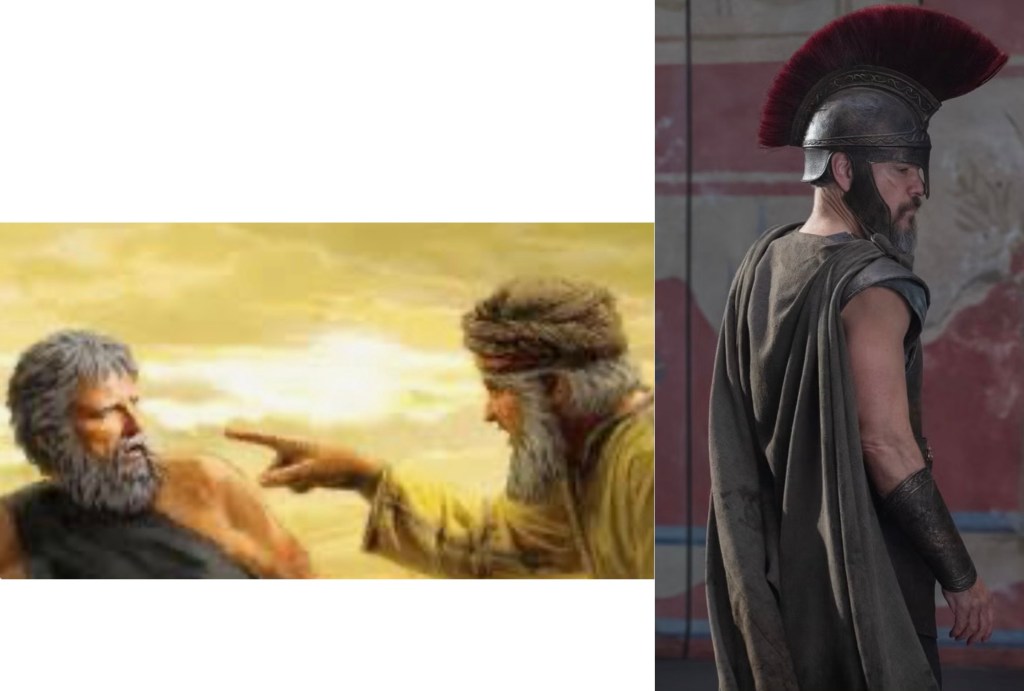
It has been mind-boggling to me that a classic I struggled to teach to both high school and college students and which was written over 3,000 years ago is a major hit in American film audiences these days. Thanks to Christopher Nolan, director, we have his remarkable film, which, I understand, is sending countless students to the troughs of translations before class time. They are sure that their Latin or World Literature teachers will be taking them over the waves of the sea or having them meet strange creatures that accost Odysseus and his men. Oh my! What an adventure!
I was amazed as I sat in the theatre watching Nolan’s rendition of the story, how much I would remember from about 50 years ago. The Achaeans (Greeks) waging war against Troy (Turkey) for 10 years; Odysseus drifting for another 10 but determined to get to his beloved city of Ithaca and eventually to his wife Penelope and son Telemachus to restore the kingdom he had left behind. Of course, I am leaving out much of the detailed narrative: the frightening Cyclopes; the witch-goddess, Circe; the angry Poseidon.
The story encircles Odysseus who bravely fights off evil in his effort to return to Ithaca. The gods appear to be angry with him, notably Poseidon whose son is Cyclopes and whose one eye has been blinded by Odysseus’s men in their fight to escape the wrath of Cyclopes. Poseidon, the god of the sea, in retribution, churns the waters above the boat then submerges it, driving the men to near death, but they prevail. Once on land it seems that Odysseus’s crew is constantly running from the terrors of island dwellers but by some omniscient plan, they overcome the tests and continue the journey.
Homer, the poet of both The Iliad and The Odyssey is entirely unknown. In fact, there are scholars who think both poems may have been composed by a group as was the practice for epic poetry of the day. Whether it was Homer or a group, The Odyssey relates to the relationship of the human with the gods. The ancient Greeks believed that a universe of gods oversaw every aspect of our being and punished us for our infractions against whatever realm they controlled over us. They revered their gods deeply because they understood the difference between the human and the god. They were not monotheistic (believing in one God) but they understood there was such a thing as supernatural power and explained it in terms of the powerful god and the subservient human. A major importance of this epic is the religious tone of faith and the humility demanded of a good person seeking to right the wrongs done to others. This is always done through adversity suffered by the good person and a commitment to the greater well-being such a person seeks for others.
Reflection
We study epics for the narrative, the culture, and the relationship to us some thousand or more years later. There are always meanings about life, faith, relationships in these stories. The Bible, especially the Hebrew Scriptures, is often seen as a mythological epic. Early Christianity experienced its growth after acknowledging that there is only one God even though Hellenistic, or Greek culture, was difficult for Greek converts to give up. They were not pagans, however, so they understood the compassion, mercy, and justice of some God, somewhere. The Bible is an epic in much the same way. There is good versus evil, heroes versus villains, and journeys, lots and lots of them.
How can we relate in a religious way to a mythological story? You may think your life is boring but let’s look at it differently. Are you wondering why you lost your job when you were doing so well? Why do you face a physical affliction you can’t overcome? Why must you move your residence? Why did God take your spouse or child or beloved person? And there are more ‘whys’ we face as humans everyday as humans did since God created us.
In the beginning of Job’s story in the Hebrew Scriptures his troubles begin to increase, but he does not question God’s care for him: “We accept good things from God; should we not accept evil?” (Job 2:10) But as his troubles mount, he begins to wonder ‘why.’ And he shows his hurt physically so that three of his friends do not recognize him when they come to offer encouragement. What follows is standard for epic tales: debates on faith and God’s power and the place of humans in the universe of creation, especially when facing great troubles. The arguments of the friends prime Job for what finally begins in Chapter 38 with the argument of God to Job. It is a blend of a mild scolding or the comeuppance of Job by a loving God who asks who are you to question my ways, my decisions, related to you? From this chapter to the end of the Book of Job is one of the most poetic narratives in the Hebrew Scriptures. I suggest you read it and take note of how God expects a good person to react to the troubles he encounters in life.
Perhaps Homer was aware of the place of God, or gods, in similar human desperation. The Odyssey makes Homer look as if he was moving toward such a belief. I suggest you read Job along with The Odyssey (it’s not that long), before seeing the movie. But most of all, I suggest you reflect on your own spiritual attitude about the challenges you are experiencing and how God fits into those challenges for you. Never blame God for trials or evil in your life. This is part of the human condition. God will see you through your troubles. God will walk you home.
Note: A great translation of The Odyssey is one by Emily Wilson from Cambridge University.
Enjoy your summer!


Leave a Reply