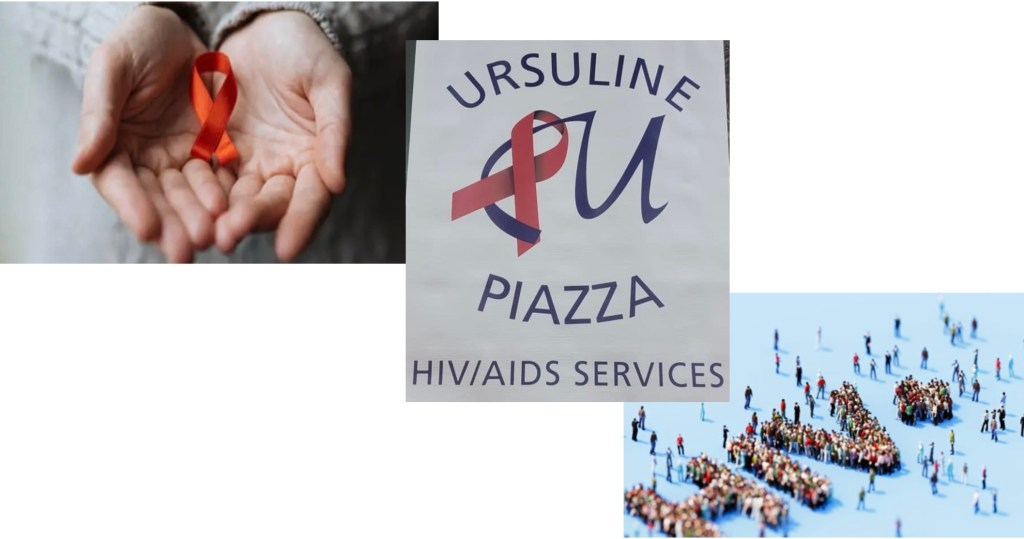
At a retirement last week, it occurred to me I had not posted a spiritual reflection on the ministry to and social concern surrounding people with AIDS and the Catholic Church. But that is not entirely what this post is about. The Church, for instance, has been debating the morals, ethics, and theology involved since the 1980’s when the AIDS crisis hit its peak. That’s a huge debate not suited for a thousand word blog. In some research I have come across, however, writers have unabashedly reported that the Church has done the most of any religious groups or even social groups to provide assistance and compassionate support to persons with AIDS or who are living with HIV.
No, this blog is about the ministry of a woman religious who founded a non-profit named Ursuline Piazza, piazza meaning an open, public place in major cities where all are welcome. The concept was used by St. Angela Merici who also founded the Ursuline Sisters in which Sister Susan, my friend, is a member. (She is also the exacting proofreader for this blog and the creative selector of the pictures for the blog.)
A few facts may be helpful first. There are, roughly, 1.2 million Americans who are living with HIV and 38,000 annually join this number. About 13% do not know they have it; 22% are heterosexual and 7% are drug users. Despite the controversy concerning the use of condoms and the debate over gay marriage, the Catholic Church is the major provider of support for people with AIDS all over the world. But what is unique about Ursuline Piazza is that it addresses gaps in services focusing on vulnerable populations such as the indigent, mentally ill, addicts, and struggling families. According to its website, Ursuline Piazza helps clients navigate doctors and the health system, find housing, and understand the social service systems. Ursuline Piazza sponsors parties throughout the year for clients to socialize and enjoy meeting people. At least once-a-year a spiritual retreat is offered at a nearby retreat center where poets, writers, musicians, and artists offer insights from their crafts and encourage client participation. I have witnessed amazing instances where clients found their voice climbing out of the detritus of their lives at these retreats.
Reflection
In a June talk given at Georgetown University, Cardinal Robert McElroy pointed out to Pope Leo’s “deemphasis sexual morality and to a Vatican report’s recommendation of a more pastoral approach to people of faith with same sex attractions.” The Pope said in April, “I think it’s very important that the unity or division of the church should not revolve around sexual matters.” McElroy quoted the pope as saying that when people argue about morality, the issue almost always centers on sexuality when “I believe there are more important issues such as justice, equality, freedom of men and women, freedom of religion, that would all take priority before that particular issue.”
Obviously, HIV/AIDS is not just a gay issue. As mentioned above, a percentage are also heterosexual. The suffering of family members of both gay and heterosexual people with AIDS is often overlooked. And those painfully hiding their sexual proclivities suffer in silence. Once while I was teaching college, a young man came to talk to me. I had all the requirements for the major ready before he arrived, surely that was why he was coming. After the pleasant amenities, the young man broke into tears, his head buried in his hands. Slowly, methodically, he told of being lonely, of wanting to have a relationship, like his friends had with women, but he knew it would be unfair to any woman. His friends began to tease him about not flirting with a girl. He knew he was gay but was terrified that his friends would find out. I told him I was not a counselor and got him to agree to see one from our counseling department. After several months he returned to thank me for steering him to counseling saying it was very helpful and, in fact, he was actually proud of his being gay. He realized God was not disappointed in him, and he was slowly finding his way of being comfortable in his ‘gayness.’ Since then, I have met others who have broadened my mind and heart as they walked the journey of being ‘different’ and helping me to see what it means to be different. But I have come to ask: Are any of us different? If so, different from what? Is there a measure of difference from the norm? What do we mean by ‘the norm?’
Maybe this week, we could meditate on the blessings we are to each other no matter our ‘differences.’ Perhaps that would dissolve the divisions among us, and we would learn from each other rather than guard our petty fears in the shadows of prejudice.
Thank you, Sister Susan, for nearly 20 years of service to Ursuline Piazza and may the ministry continue as long as needed!!


Leave a Reply