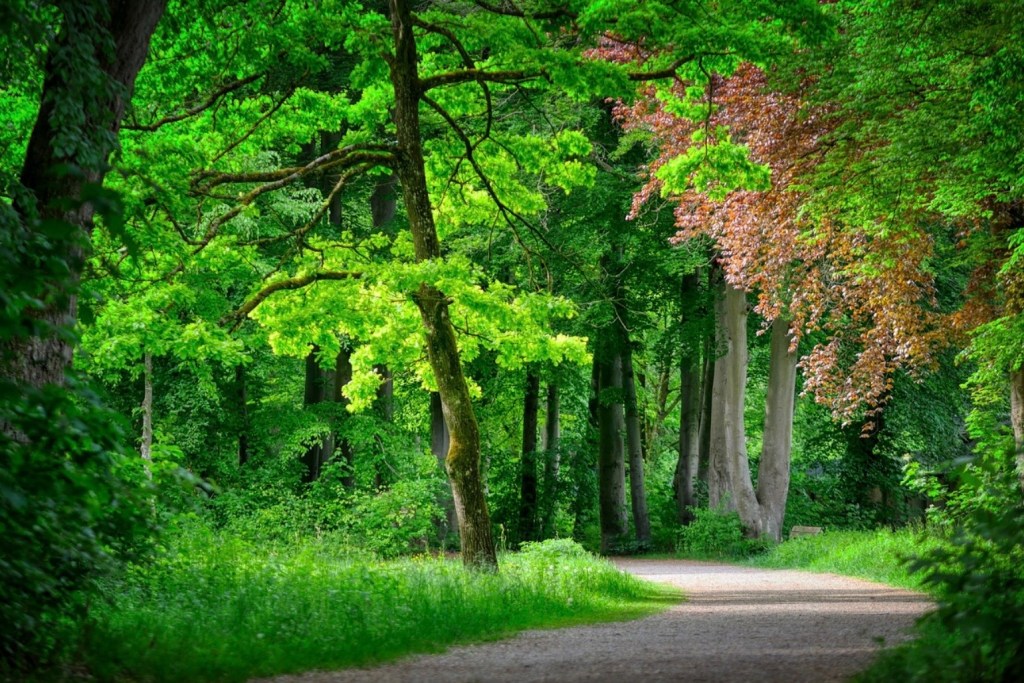
As summer has ended and fall begins its slow but beautiful incursion into our lives, we will still get some lingering days warm enough for an activity outdoors. Some of us might enjoy hikes that are bereft of mountainous terrain and treacherous environments, more like the challenging but milder terrains that State Parks offer at least in parts.
A pilgrimage is similar to a hike. One has to have determination to get through to the end of the experience. It is invigorating and yet tiring but a sense of achievement rounds out the experience once it is completed. I’m addressing spiritual pilgrimages in this blog, but I know there are wellness pilgrimages, even athletic ones. Chaucer was on to something as he wrote The Canterbury Tales, one of the most famous pilgrimage narratives written in 1478. His pilgrims were on their way to the Shrine of St. Thomas Beckett in Canterbury. The story each pilgrim tells helps to provide entertainment on the way sometimes a bit bawdy as would be expected for a medieval tale. Pilgrimages were very popular already for centuries and most had a religious theme.
A very famous spiritual pilgrimage was that taken by St. Ignatius Loyola in 1522 and still followed today by Christians and interested pilgrims. His pilgrimage began in Loyola where he lived and ended in Manresa, both in Spain. Ignatius had experienced a religious conversion during his recuperation from a massive leg wound having been shot by a cannonball in the battle of Pamplona. He was a military man now confined to reading the Bible and The Lives of Saints, the only reading material available to him. There, in the quiet of the family castle, Ignatius let these books speak to him and he became certain that God was calling him to a depth of spirituality he found exhilarating and mysterious. He had to determine that type of spirituality and what it was that drove him to make it real.
Thus, he embarked on a private pilgrimage ending with the writing of The Spiritual Exercises, the classic guide for the spiritual life. The journey Ignatius undertook was 340 miles not an easy trek for a man who had recently nearly lost his leg in battle. At Manresa he wrote The Spiritual Exercises in almost complete solitude experiencing ecstasies as he listened to the Divine Messenger at work in his soul. The Spiritual Exercises are comprehensive and eternal for their subject matter of good v. evil, abandonment to God’s will, discernment, possessions v. poverty, humility v. pride, etc.
Some retreat centers operated by the Jesuits (the religious congregation founded by St. Ignatius) maintain a pilgrim’s trail on their grounds which retreatants use as a minor facsimile of the real trail Ignatius followed. Many non-Jesuit retreat centers offer the same. Ignatius saw himself as a pilgrim seeking his God.
Reflection
You’ve always wanted to visit Camino Ignacio, perhaps. Or maybe Lourdes, Fatima, Guadalupe. These are meaningful, sacred places that shower graces on the pilgrims who visit—and there are more throughout Europe. Certainly, the Holy Land is the apex of all places for a pilgrimage, but this appears to be out of reach currently. When many people could not secure the funding necessary for a pilgrimage even in the medieval centuries, they turned to what the retreat centers or monasteries could offer. You can make a pilgrimage alone on one of these trails or with a group.
Is a pilgrimage just a lonely trail? A pilgrimage usually includes places of significance related to the subject, i.e., a cave or even a building where something of major importance took place for the person/subject of the pilgrimage. Along the way are stops for prayer and reflection about some event in the subject’s life or related to it.
Did the person/subject of the pilgrimage determine where it begins and ends. Most pilgrim trails begin where the subject/person had an experience which inspires him or her to take a journey that will end with a teaching or a resolution of an issue or a course of action needed. For instance, St. Ignatius asked God to let him know what he must do next since he was called during his recuperation. He begins his pilgrimage with that in mind and ends it with The Spiritual Exercises being written.
Can a pilgrimage include stops along the way that are spiritual in meaning but not necessarily related to the subject/person? For instance, can it include a pause to reflect on children or the elderly? Yes, especially if there is connection with the subject/person.
I strongly suggest you look into pilgrimage paths and check retreat centers near you for this. The cost today for foreign travel is, unfortunately, prohibitive thus preventing many seekers from experiencing a pilgrimage in the actual place where something very special happened. But you can welcome many graces and find solace and even direction about something by doing a local pilgrimage. For instance, the Jesuit Retreat Center where I work in Parma, Ohio, has just completed a pilgrimage path on its beautiful property. A group of lawyers from our local Lawyers Guild will be making an Ignatian pilgrimage here soon.
Retreat centers all have websites and contact information. It’s yours for the asking. Do not be timid. You don’t have to be Catholic either. This might be just the spiritual activity you need as autumn advances. Lace up, hoist the backpack, and happy trails to you!!!
Blessings to all my readers and my Anonymous Angels. It’s been a summer like none other for me and I am well and enjoying life with little Lily!


Wonderful explanation of the beauty of the pilgrimage. I made my first one when I was 8. My Nana took me to the National Shrine of Our Lady of Consolation in Carey, Ohio. I’ve been an avid hiker and pilgrim ever since!
LikeLike
Good chilly morning!Love the pilgrimage blog. It has awaken
LikeLike
Sr. Mary Ann,What a wonderful (and timely) reflection. I am off next week for a pilgrimage and retreat on the Isla of Iona next week – getting in touch with my Celtic roots. I hope all is well with you and Lily in your new home. Miss you lots!BillBILL HOBBSFounder | The PIlgrim Journey703-307-4881bill@thepilgrimjourney.comwww.thepilgrimjourney.com
LikeLike
Bill: So happy to get your message. I’m doing well in my new apartment and appreciate still being in lovely environment near the park. Wow! A retreat in Ilona–I wish you a wonderful experience there, full of God’s presence. We Celts have such a deep reverence for that Presence in nature and the howling seas. I have thought of you so often. I’m getting back to more direction at JRC since my eye is healed. Have not met the new Commander yet but he appears in October I’m told. I am thrilled that I was allowed to bring Lily here. She has made an immense impact on residents and employees. Now that I have your email address, I’ll reach out more often. Meantime, enjoy your retreat and draw closer to this wonderful, exciting and loving God of ours. Warmly, Mary Ann
LikeLike