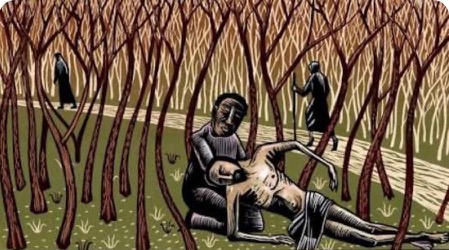
Artist, Kreg Yingst
The gospel reading for one of the mornings this past week was The Good Samaritan, a well-known and appreciated story that everyone seems to love. After hearing the gospel, I came across the cover on the publication, Give Us This Day, for the October liturgies of the Catholic Church. It is a picture of an ink block rendering of the story created by the American artist, Kreg Yingst. The piece provides a powerful reflection because of its American timeliness and setting. Yingst places the scene in what could be a forest or woodland in America. It is not the typical depiction of the road from Jerusalem to Jericho which would have been an intensely rigorous, dry and ‘hilly’ route because Jerusalem sat at 8,000 feet sea level and Jericho at 800. The road was edged with bushes of sharp needles ample enough for robbers to conceal themselves.
It is important to remember that the story opens with Jesus taking a question from a lawyer who asks, “What must I do to inherent eternal life?” When Jesus asks how the lawyer reads this question in the Law, Jesus replies he is correct. But the lawyer wishes to justify himself and asks another question, “But who is my neighbor?” One of the greatest stories in biblical literature is then told.
Often, we think of the story as a simple version of the many daily opportunities we have to provide mercy and love for someone in dire circumstances: the street person who asks for assistance, the person we encounter who needs a shoulder to lean on or advice in his or her distress, the friend or loved one waiting for our phone call. In all of these circumstances we are usually busy, but we give the help hoping to be pure in doing so, no judgment involved, no chastisement of the one who needs our help. We try. We are Good Samaritans.
However, if we employ a scale of need which includes political realities in such encounters, we are often tempted to relent. We pass the person by; we are not the Good Samaritan.
For example, take a good look at the image that Yingst has created. The Samaritan is obviously of different ethnicity than the victim. There’s a good chance they are enemies. Jesus has chosen the Samaritan because of the virulent hatred that existed on a religious basis between Samaritans and Jerusalem Jews. Samaritans were considered errant Jews; a faithful Jew would ignore a Samaritan, and a Samaritan would be wary of a Jerusalem Jew. Note the hooded figure walking at a distance from the two. He could be the Levite or the priest both of whom belonged to the same tribe of Levites since all priests had to be Levites, but not all Levites were priests. Both held high positions in the Temple by virtue of their inherited calling as Levites. The priests performed liturgical Judaic rites; the Levites were their assistants in caring for the Temple and its many needs. You might say that in Jewish hierarchy, these fellows were at the top. (Note the role they played later in the Passion of Christ.) Both men ignore the victim, possibly and mistakenly thinking he is dead and in their legalistic ritual, they are forbidden to touch a corpse. Likewise, they are forbidden to touch the blood of a near dead person. I picture the man whimpering in pain, perhaps crying out loud but the cries fall on the deaf ears of the Temple leaders whose heads and ears are amply stuffed with the laws that keep them from hearing the cries of a needy person but make them esteemed leaders of the Temple. This story is really about two worlds colliding at the expense of someone in need. Those who carry the law and political power to one extreme and someone who ignores his own safety and politics and kneels before a wounded person who is desperate to live.
Reflection
I find it interesting that even in the closing question in the story Jesus asks the lawyer: “Which of these three, in your opinion, was neighbor to the man who fell in with the robbers?” The lawyer, a man familiar with Judaic and Levitical law responds, “The man who treated him with compassion.” He could not say ‘the Samaritan.’
The Jerome Biblical Commentary on this story concludes, “His love (Samaritan’s) was spontaneous and did not have to inquire into the Law; it was disinterested, kindly, personal, and effective…the definition of a neighbor.”
What should be our reaction to wounded migrants or the misinterpretations of the law calculated by politicians to fit the unjust treatment of persons different from us? In what ways can we stop on the roadside of someone’s journey and bind their wounds no matter their ethnic origin or religion or criminal record, or even their distrust of our motives?
Most of us can pray or join prayer groups to help heal the divisions between us and to heal the persons retained in horrible conditions and the persons who cry for help in the disgust of fetid and unsanitary cells waiting to be heard. We can walk in protests peacefully, speak out at rallies and meetings on behalf of victims. And we can and must vote! We must help those closest to us to understand why and how we are each called to be Good Samaritans, to weep over the victim we meet in reality or on the evening news. How much better will our world become if during our evening Examen we see where we could have been a Good Samaritan or where we see that we gave that loving hand to someone as we traveled from Jerusalem to Jericho.
I pray for each of my readers and very much appreciate your reactions to this blog. I cannot answer all the responses because of my program directions and my time. However, I read what you send and take note of the ‘likes.’ And even if you don’t send a response, the analytics of Word Press regularly inform me the numbers of readers and what subjects were most read. So, the publishers like you, too!


Leave a Reply