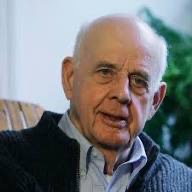
This past August the amazing giant of ‘environmental spirituality’ passed to the next life at age 92. Writers, scientists, and farmers, in general anyone who loves the Earth and its generous, bountiful soul, were saddened to learn that it’s iconic advocate and lover, Wendell Berry has moved on. Surely, the Earth weeps.
Novelist and fellow Kentuckian, Barbara Kingsolver’s sensitive and probing apotheosis of Berry appeared in The New York Times Book Review, October 4. Kingsolver understands the unique creativity that true rural life absorbs first as seed then nurtures into fruit. So many writers, musicians and entertainers have emerged from Kentucky and West Virginia, the basin of beauty and creativity and its driving force of poverty. I remember spending time in the ‘hollers’ where our sisters worked, especially teaching children and adults to read and I follow another Sister of Charity of St. Augustine who, as a nurse, started a health care ministry, now flourishing. So grew Berry and Kingsolver and many others in this simple, lovely land.
Berry earned an undergraduate degree and a master’s degree at the University of Kentucky before distinguishing himself as a Stegner fellow in writing at Stanford and then taking a faculty position at New York University. Increasingly, he grew restless among the academic literati who probably thought as Kingsolver put it, “that a Kentucky farmer-poet would be doomed as a literary nobody.” But truth was that Berry was feeling the irresistible pulling, luring, throbbing of the land where his heart had remained. He had to return to Kentucky, to prove that its stories and its beauty could be illuminated for the wisdom we could all learn from them. Berry’s love for the land converted him from an academic back to farming. He had to prove his ‘better self’ as Kingsolver said, was working in the fields that helped him develop this better self.
He set about to prove this through committed activism for the environment and through his writings: 25 books of poetry, 16 volumes of essays, and 12 novels. He came to know Thomas Merton, the famed Trappist monk, in the late sixties and remained a friend until Merton’s untimely death. I notice a thread of influence of Jesuit Pierre de Chardin, priest-paleontologist whose writings inspire deep reflection on the connection between science and spirituality, between our natural existence as humans and the natural world. Berry considered that “…the fragment of the earth that is now me is just passing through: It is on its way from having been a tree, a school of fish, a terrapin, a flock of birds. It will pass through all these forms again.” A whiff of Chardin in those words, I think.
Kingsolver points out that Berry had the “rare vision to see a thing, anything, not just at the moment of acquisition but through its whole passage from mineral extraction, the mess of manufacture and transport to the consumer and beyond, to the desecration we call ‘landfill.’ He would ask, “Is my need important enough to inflict this injury on the world?” Thus, he eschewed the purchase of a computer because “he saw a danger in the thinking that new things are always better than old things.” One of his most famous essays detailing this decision is “Why I Am Not Going to Buy a Computer.” Still, you couldn’t call him a Luddite; he welcomed a tool that made life better and helps us to do good work.
Reflection
Berry lived his religious life as a Baptist, “like a good southern boy,” as one pundit said. However, he lived it with graceful criticism, digging deeply into the meaning of scripture that molded his thinking. I think that if we look at his six arguments for focusing on the good and right life, we can see a spirituality that any of us can adopt for our own commitment to faith and creation. He argued for participation in sustainable cultures; for using small scale and localized technologies; for having a deep connection to the place where one lives; for taking pleasure on growing and eating good food; for the ethical care of animals, and finally, for supporting local economies. Like Chardin, he lived a cosmic vision of life and death believing that eternal life is absorbed into the natural life and all is embraced by our Creator. Thus, he saw no contradiction that persons who leave us in death are living a peace we often do not think of in our unconsciousness. It is wise to contemplate that what bonded us in the earthly life, our human love and our love for our home, the Earth, will bring us together again. His poem, “The Loved Ones” says it so well.
“The Loved Ones”
The loved ones we call the dead
depart from us and for a while
are absent. And then as if
called back by our love, they come
near us again. They enter our dreams.
We feel they have been near us
when we have not thought of them.
They are simply here, simply waiting
while we are distracted among
our obligations. At last
it comes to us: They live now
in the permanent world.
We are the absent ones.
— Wendell Berry)
I encourage my readers to check out Berry’s work on Google. You might want to start with his book of essays Sabbath Poems and his first novel Hannah Coulter.


Leave a Reply